Tuesday, 12 April 2011

The Hypocrisy of the Palestinian Authority

0 comments
By Joseph Daher
(Student at SOAS) 


In a conference in Geneva called "women in resistance" Leila Shahid, representative of the PA at the European Union, spoke with great enthusiasm about Revolutions in the Arab world and of youth movements around the region. I therefore asked her what is her position towards the youth movement in Palestine, as she did not mention it at all. They have actually been attacked, arrested, and kidnapped by Fatah thugs and Palestinian Authority mukhabarat for demonstrating in the streets of the West Bank since the 15th of March. I asked her how can she speaks about plural and democratic society while the PA is repressing demonstrations and protesters now, as well when Palestinians wanted to show their support during the Egyptian and Tunisian Revolutions.

I told her that the President of the PA supported until the last day Moubarak, so how she differentiates from him. I told her several groups of Palestinians and supporters of the cause as me demonstrated around the world and in Palestine on the 15th of March to end the division, but also chanting songs as "end Oslo" or calling the "PA a collaborative state". For many of Palestinians and supporters, the PA represents the opposite of any form of resistance, more busy protecting settlements than Palestinians. This youth movement is a way to come back to principles and fundamentals of the Palestinian cause: any kind of resistance and not collaboration, what is her position I asked her?

Leila Shahid: The envoy of the Palestinian
Authority to the European Commission
She basically answered me that I don't live in Palestine so I should not talk like this and that I was ideological in my statement. She added that I should go demonstrate in front the Israeli embassy to ask for the end of the occupation instead of going in front PA representations. She avoided answering to my intervention and questions on what is happening in the West Bank now, while this was a conference organized around the issue of women in resistance, she also did not comment on violence perpetrated against women within the demonstrations in March, while we were providing her with evidence that it happened.

During the rest of the conference she was challenged by other members of the public and of the panel for not answering my question. She turned down the question and was aggressive against everyone. She repeatedly said she was proud to be a representative of the PA.

I personally salute what Leila Shahid did in the past for the Palestinians, but using credentials of the past cannot be in any way a justification or an excuse for what is happening now on the ground and for the behavior of the PA.

On the issue I can’t criticize the PA because I am not Palestinian, I disagree with this argument. I support the Palestinian cause and I am not Palestinian, I believe it is an Universalist and humanist cause, but the same way I support this cause, why should I not be allowed to criticize the PA on humanist principles. I don't think you have to be of a particular nationality to be able to support or criticize anything.
After this is not to say I take the place of the Palestinians in anyway, which I did not in anyway, did I ever say the Palestinians should do this or this? No! This is their own right! 

Few close Palestinian friends reacted to this “clash” after I sent them a resume of it. 
Here are few comments:

“It is more urgent than ever for the Palestinians to reclaim the PLO, their national institutions via direct Palestine National Council (PNC) elections, so that Palestine Liberation Organization representatives speak for them, and not against them!”

 “It is very ridiculous that whenever we criticize, shame and blame the PA for its irrational and illegal conduct, the given answer always is: Please go and use this energy against the Israeli occupation instead of the PA...How long should it take them to understand that the occupation does not path the way for the PA to commit crimes against its people. The occupation is the major creator of the mess Palestinians are sinking in, yet one should not be blind to the blunt truth that immorality remains immorality, it is not a subjective term that goes according the body that practices it...And truth should be said the PA reflects immoral actions towards Palestinian people”

“Interesting how they immediately shift to "you should protest against the occupation " argument “
The March 15th movement is driven by the youth it is in part aimed at a civil Palestinian mobilization to end the catastrophic political factionalism. But it must be placed in the larger context of reclaiming the struggle to liberate Palestine. March 15th calls for an end to division, but this does not mean confinement to mere reconciliation rhetoric. In fact, the organizers explicitly demand the re-democratization of the Palestinian National Council and the establishment of new electoral law inclusive of all Palestinians inside and outside Palestine & Israel, stating: ‘Our demands for change go beyond ending Palestinian disunity and partial tweaks to the status quo. We insist on full democratic representation for Palestinians all over the world.’

It was actually the hijacking of the Palestine Liberation Organization by Fateh and the Oslo agreement of 1993 that excluded other parties as well as the Palestinian people from the decision-making process, and that undemocratically substituted the resistance doctrine with cooptation, concessions, and negotiations.
Therefore, an end to the division requires a thorough and substantive change of the entire framework of Palestinian politics.  Oslo must be put to an end, its birthchild the PA dissolved, and the PLO redefined as a representative movement inclusive of, amongst other parties, Hamas.

March 15th has invigorated Palestinian civil society.  In a reactionary move, Palestinian parties like Hamas, Fatah and Fayyad’s government are attempting to co-opt this grassroots non-aligned initiative by calling on their part for ‘End the Division’ protests. The PA and Hamas have expressed both rhetorical support for an end to division while simultaneously confronting the previous demonstrations in Ramallah and Gaza with violence and arrests. Hamas police also repressed many of protesters of the March 15th movement, killing one of them, while attacking and sexually assaulting some demonstrators.

As the PA continues to get bankrolled on American dollars and to engage in security cooperation with Israel, and as Hamas continues to dominate Gaza on the basis of the continuing fragmentation of the Palestinian struggle, it is unlikely that either side of the divide genuinely wants to put it to an end.


In conclusion, my intervention and my question was a way to salute the bravery and the determination of these young Palestinians-claiming, far from any factionalism such as Fatah or Hamas, the roots of the Palestinian cause: Resistance.  This notion of Resistance is crucial today against the continual aggressive behavior of the Apartheid, colonial and Settler State of Israel. The youth movement is reminding to the different political parties, and especially the PA, that the real enemy is the Zionist State and not other Palestinians, while the objective should be liberation and not the quest for power.

Monday, 11 April 2011

An Academic Piece On The Origins of the 1948 War: al Nakba or Milhemet Haatzma'ut?

0 comments
By Nadia Marques de Carvalho
(LSE Student)

The essay below details an event in history that has really moulded and determined the world we live in today. To understand, let alone resolve it, it is so important to go beyond the 1967 boarder line, you need to go back to 1948: the defining year of Catastrophe and "Independence".
 Or even better go back to 1882. 


The 1948 Arab-Israeli War was the inevitable result of decades of bitter, protracted and intractable hostilities between two national movements that embody a tangled and tortured history. The thesis of this essay maintains that the quintessential origin of the 1948 War is the clash and the inability to coexist of the Zionist movement and the Arab-Palestinian National Movement.  This clash shall be explored in four main parts; the impact of Zionism, Britain and its Mandate, effects of rising Arab-Palestinian Nationalism and the United Nations (UN) Partition Plan. The different names for this war; al-Nakba and Milhemet Haatzma'ut, in themselves highlight the conflict of both narratives, ergo different ‘origins’ of the war. For Palestinians, Zionism is an outpost of colonialism, inherently belligerent and expansionist, bent on driving the Palestinians from their land, thus causing for them to react with hostility. Zionists, however, feel they have to act decisively to secure the Jews’ right to an independent state on their ancestral land: it is the aggressive Arab-Palestinian rejection of their right to a sovereign state that has caused for them to resort to violence. The ‘origin’ suggests the beginning, and it is arguable that the beginning is with Abraham’s Covenant; nonetheless for the purpose of the word-limit this essay shall only address the history of the 20th century.

Lord Balfour
Britain’s Three Promises and it Mandate of 1920 created the historical conditions for the successful implementation of the Zionist Project. It set the framework for the colonization of Palestine and the disenfranchisement of its own people, thus inducing the clash between two national movements eliciting the catastrophic war of 1948. The Promised Land, which became twice promised, is one of the origins of the war. The McMahon-Hussein Agreement, the Sykes-Picot Agreement and the Balfour Declaration Britain made contradictory, irreconcilable and ambiguous promises. Under the Balfour Declaration, in 67 words, Britain became, “one nation promising another nation, the land of a third nation”[1]: Britain provided the protective umbrella for the establishment of a “Jewish National Home”[2]. The Balfour Declaration referred to 90% of the population as “the non-Jewish community in Palestine”: it was this arrogant, dismissive and racist tone that highlighted Britain’s pro-Zionist stance: thus the Palestinians need to resist. The Balfour Declaration was arguably the original sin, “creating a gangrene of suspicion and mistrust in the British-Zionist relationship in Palestine”[3], which was to haunt British rule for the next three decades. Britain’s colonial ambitions concocted with the expansionist Zionist ideology prompted a fearful and hostile Palestinian response.

The clash between Zionism and Palestinian Nationalism was not allayed during the British Mandate (1920-1948) but dangerously fueled. In essence the British Mandate favored the Zionist cause[4] but by aiming to implement the Balfour Declaration, the British set up irresoluble and incongruous goals of self-rule of Palestinians and a national home for the Ashkenazi Jews. This fueled Zionist-Palestinian tension and can be identified in economic, political and social policies. Palestinian land was being leased to Jewish Settlers by British authorities (by 1947 this was 195 000 dunnums – 70% purchased by PLDC)[5], this land was then exclusively for Jewish use[6]. The withdrawal of so much arable land from access/use by Palestinian peasants to economic hardship and became a threat to Palestinian sovereignty. Palestinian activism and hostility against Zionism were higher after periods of high transfer; indicating that land acquisition was a strong cause of enmity. The mandate also permitted the Aliyahs, Jews would then come to inhabit land bought for them:  it allowed for the rapid change of demographics without Palestinian consent: immigration and the growing presence of Jews only made real the threat that Palestinians faced.

The Jewish Agency
The British Mandate provided settlers with monopolistic concessions and industrial protectionism, which facilitated the building of an exclusive Jewish economy.  Britain provided for Jewish enterprises in an “incoherent but clearly recognizable” [7]protectionist policy and preferential tariffs, this is exemplified in the Atilt Salt Company, who had artificially high salt prices which hurt all Palestinians as salt is a staple food. Pro-Zionist policies, which favored the separate Zionist economy, only fueled its success as well as Palestinian resentment. Consenting to the bifurcation of the country’s economy and by helping to create a Jewish privileged enclave, the British enhanced the chance of Zionist success in Palestine, ergo another reason of Palestinian resistance. Politically, the British mandate permitted for the Jewish State within a State by allowing for the establishment of an independent Jewish Agency, which was well organised and well financed, ergo able to mobilize the Jews. This autonomous Zionist nucleus allowed the Zionists to “conduct an affective internal war, against the less-organised and financed Palestinians”[8] Moreover the rejection for the Palestinians to have their own centralized and independent political agency only electrified anti-Zionist passions: Palestinians began to feel economically and politically oppressed.

Pro-Zionist British social policies fueled Palestinian resentment. This is exemplified in the decision to make Hebrew an official language, even though Jews only constituted of 10% of the population. Britain also financed a separate and exclusive Jewish school system whilst denying Palestinians a private education system. In 1944 only 32.5% of Palestinians were enrolled in school, compared to 97% of Jews[9]. Pro-Zionist policies under the British Mandate attempted to choke Palestinian nationalism whilst promoting Zionism. Balfour’s claim in 1922 that, “Zionism be it right or wrong, is of far profounder import than the desires and prejudices of the 700 000 Arabs who now inhabit that ancient land” [10] not only embodies Britain’s pro-Zionist stance and its view of the Palestinians as a backward, Oriental, inert mass but also its amoral attitude to the future. This in essence accentuated the clash between both identities.

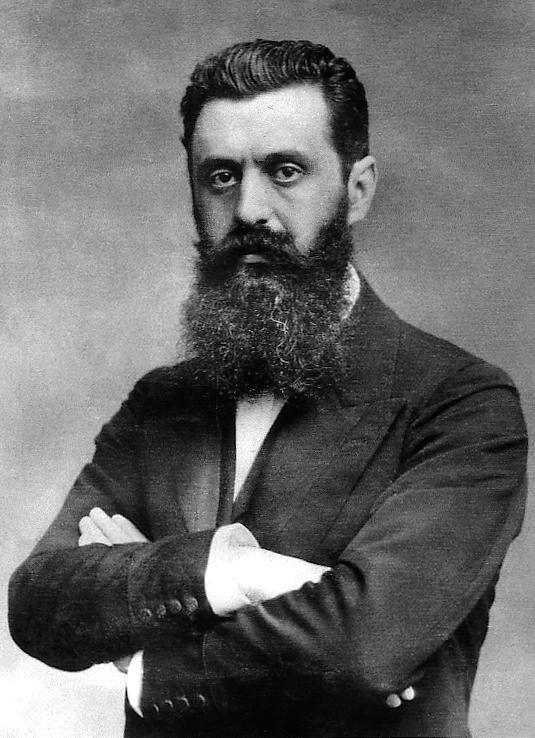
Theodor Herzl
The origin of the 1948 War can also be identified in Zionism: “an arrogant, insolent and provocative ideology…that would precipitate a catastrophe”[11]. Zionism’s core aims were to establish a Jewish state on their ancestral land, this would have to be done through “force and the Arabs will have to go, but one needs an opportune moment to make it happen, war”[12] highlights Zionism’s preparation for an inevitable war that would decide destinies. Hence the very origin of the war can be identified in the inability to coexist of Zionist aims and Palestinian Nationalism. Nonetheless Zionist aims were actualized by the British mandate and by its own initiatives. Socially, politically and economically Zionism had secured its presence through the Jewish Agency, its own private schooling and health care service and its separate and successful economy: this was all making of the Zionist reality which would then “deal militarily with the demographic reality”[13]. Ben-Gurion’s words embody Zionism’s urgent militancy, words which fueled Palestinian fear of this aggressive and expansionist ideology.

One of the origins of the war was that to achieve Zionist aims one needed the right opportunity: the only way to do this was to fuel nationalist tensions, secure a Zionist entity and prepare for war. Zionism did so in four distinct ways: informative preparation, military preparation, support overseas and the exploitation of events. Informative preparation is epitomized in the Village Files. This archive recorded topographic locations of each village: from access roads, ages of individual men to “hostility” towards Zionism, “quality of arms at disposals” in each village. The Village Files are evidence contrary to the standard Zionist narrative that the 1948 war was an attack on the Jews just because of the rejection of Resolution 181: these archives started in the 1920s show a movement preparing for war. Yigael Yaldin comments that “it was this detailed knowledge that enabled the Zionist military command in 1947 to conclude the Palestinians had nobody to organize them; it was the right opportunity.[14]” Military preparation is evident with the planning of the Haganah, (theft of arms from British barracks)[15], its military experience in WW2 and the offensive position of the Irgun and LEHI[16]. These groups played an important role in inciting hatred and fear in the Palestinians; sporadic terrorist attacks on Palestinian villages as well as the British and the 1936 Arab Revolt gave these groups a chance to practice their skills. Support overseas was also of essence to a Zionist success, and is characterized by the 1942 Biltmore Conference. The resolution reached at this conference called for the opening of Palestine to immigration, and that “Palestine should be established as a Jewish Commonwealth”[17]. The Biltmore Conference gave to American Zionism by appealing to the West’s guilt of allowing the Holocaust to occur. Zionism had managed to initiate a global pro-Zionist movement through sympathy, whilst simultaneously launching attacks on Palestinians. Zionism’s aims to create the right opportunity elicited Palestinian fear and fueled Palestinian nationalism.

The origin of the 1948 war can equally be found in the Arab Palestinian’s hostile and antipathetic reaction to Zionism and Resolution 181. The Arab mobilization to defend Palestinian Sovereignty was a militant and threatening response, endangering Jewish presence in Palestine. The Arab League began taking “military measures’[18] such as the formation of a military committee that was preparing the one million pound armament of the Palestinians and the many volunteers sent to Palestine to “bolster local militias”[19]. Moreover before the passing of the Resolution, “Arab forces had been mobilized, equipped and trained volunteers along the Palestinian boarder”[20] and the Syrians had not only set up training camps at Qatana but also deployed thousands of troops “whose exercises were alarmingly close”[21] to the Palestinian boarder. However what was threatening to the Jews and galvanized nationalist tensions was the ominous Arab rhetoric such as that of the Iraqi Prime Minister, “If a satisfactory solution of the Palestine case was not reached severe measures should be taken against Jews in Arab countries.” [22] Not only was this a menacing threat to the Zionist dream of securing its national home but also anti-Semitic intimidation reminiscent of previous Jewish persecution electrified the clash of nationalism.

The Arab reaction to the passing of Resolution 181 drove Zionist fear and highlighted to them a dire need to fight for the implementation of the Resolution. The Middle East and North Africa was rampant with violent demonstrations and pogroms, calls for “Jihad” echoed across the continent – whereby Syria “promised to comply and be at the forefront of the liberation of Palestine.”[23] These events and political rhetoric managed to induce a frantic atmosphere burning with national fervor and forcing Zionism onto the defensive. The Zionist determination to form their own State mixed with the Arab resolve to Palestinian Sovereignty paved the path to a clash of nationalism in the three day strike, hence the beginning of the 1948 War.

The making of the partition plan and Resolution 181 sowed the seeds for war, by again spurring the clash of nationalism. “By voting for partition the UN provided, unintentionally, the signal for a civil war in Palestine.”[24] To Palestinians the United Nations was inexperienced; none of the UNSCOP members had experience on solving conflicts or any knowledge about Palestinian history[25]. Moreover the United Nations was not in a legitimate position to hand over Palestinian land to the nationalist claims of the Zionist Movement, out of sympathy and compensation for the Nazi Holocaust in Europe. Not only can the origins and makings of war be found in a biased UNSCOP but also intrinsically in Resolution 181: Jews owned 6% of land, formed less than one-third of the population but were given 56% of Palestinian land – the most fertile land went to the Jews[26]. To the Palestinians and to humanity this was “both illegal and immoral” [27]Walid Khalidi puts it succinctly, “Resolution 181 was a hasty act of granting half of Palestine to an ideological movement that declared openly ready in the 1930s to de-Arabize Palestine.”[28] Hence the UN violated the basic rights of the Palestinians, instead of calming, it heightened tensions – with an overwhelming majority in favour of partition, not only did law and order in Palestine break down but also propagated the prerequisite for the 1948 War. Nonetheless, Resolution 181 did not only fuel the Arabs and Palestinians to war but also the Zionists: Ben-Gurion made very clear in October 1947 to his colleagues that the Palestinian rejection or acceptance of the Partition Plan would have made no difference, as the Zionists would accept and work against it[29], as to him a “valid Jewish State meant one that stretched over Palestine and allowed for no more than a tiny number of Palestinians.”[30] The origins and makings of the 1948 War were only made possible by the arrogant, immoral and unjust passing of Resolution 181, which unleashed a surge of Arab and Zionist nationalism.


Nonetheless it is arguable that the War of 1948 was predestined in the contradictions between the Old Testament and the Quran, and is thus not originated in the clash of nationalism but in the rivalry of two brothers – Isaac and Ishmael. However Palestine/Israel has become another outpost of imperialism: its boarders a fiction created by rule under the Persian, Hellenistic, French, Ottomans, British and many more. In quintessence the framework for the 1948 War was set with rising Zionist and Arab-Palestinian nationalism, which was then galvanized by not only the original sin of the Balfour Declaration but by pro-Zionist British policies that alienated and marginalized Palestinians. Zionism was inherently an aggressive and driven ideology whose aims if ever were to be achieved would inevitably lead to war, and to a rise of pan-Arab nationalism. The rise of Arab-nationalism, fueled by the immoral and injustice unleashed upon Palestinians by Resolution 181 also sowed the seeds for war. War involves the need of an irrational emotional response – to go to war both your hearts and minds must have the same resolve and conviction: the events written above elicited this response – and so the catastrophe was promised. The ramifications of the 1948 War bear significant importance as peace now depends on deciphering and understanding not only the Zionist and Palestinian narrative, but recognising that when the hearts and minds are galvanised with such a passionate, irrational and emotional resolve, this translates to uncertainty that can elicit catastrophe or peace.

(for the references please contact admin)

Sunday, 10 April 2011

In The Name of "Peace"

1 comments
By Sameeha Elwan
(student from Palestine)


It is a time of peace.
Peacefully, you wake up every morning with the most peaceful intentions of leading a peaceful day in your already chaotic life.


Whether you intended or it was predestined, the voice of Fairouz with which you prefer to sip your morning coffee, peacefully, avoiding all sort of news of conflicts, death, or pain on other radio stations turns into an agonizing pain with the “bells of return” triggering in your mind, you who were destined to chant for Palestine as long as you’re forced to live elsewhere.


Peacefully, you get into the taxi while your mind is so full with the most peaceful thoughts of how to peacefully resolve the argument that might take place with your boss. You take your mind of those aggressive thoughts, and prefer to stare out of the car window longing for peace. 


Only there, your eyes meet with fixed eyes of hundreds of faces hanging on the walls of the streets. You might recognize one or two or even tens; you who have lost so many who once have been the joy of your life. They used to be the joy of your life till they were killed, shot, shelled, torn, burned, or buried under rubbles. Now, they have turned into some temporarily memorials on the walls who would soon be replaced by others.


Peacefully, you go shopping for the Eid the day before with the most peaceful intention of a usual shopping day where all you think about is whether you’d find that red blouse. The only act of aggression would be directed towards the salesman with whom you argue, peacefully. The rising clamour of people around you is suddenly replaced by screams of terror as a bombing shakes the place.


 In seconds, you resume your enthusiastic argument with the salesman, peacefully; you who learned how to estimate possible danger. You no longer need a media coverage that would assure you the bombing was carried out by an F16 in a place far away. You already know, and continue shopping, peacefully
Wait a minute,


Your understanding of the word “peace” is mistaken. Peace is no longer a “state” of mind. It is rather a process. Please be informed that for peace to be processed, certain acts are obligatory:


Forget:
Forget about the word freedom. Freedom is a relative term invented by absolute idealistic people. Freedom should always be put under extreme supervision and restriction or else it would go beyond control. You should learn to live under some absolutely not harmful restrictions. Checkpoints are only there for safety reasons and hundreds of them dotted along the road of the West bank, though would restrict your movement for a short while that might cost you the life of a human being, are put there for the sake of ensuring the Peace process.


Forget about your history. Your history is worth nothing. It should start by the year 1967 where all what was left for you was the West Bank, partially and the Gaza Strip. A history of thousands of years should be erased of your memory and you should learn to accept that Palestine is only the pieces of land scattered around the borders of 1967.


Forget about the word Return. This is a term preserved only for Jews who claim to be displaced all around the world thousands of years ago. Palestinians who were tragically dispersed all around the world sixty two years ago should learn to just live where they are.


Forgive:
Be tolerant and learn to forgive. Forgive them the wars they wage, the massacres they commit, the blood they shed, the children they slaughter, the women they rape, the lands they erase, the trees they uproot, the torture they enjoy, and the humiliation they cause. Forgive them anything, and learn to live in Peace.
Forgive them and shake their dirty hands stained with your people’s blood and draw a smile upon your face before the camera for a shameful photograph.


Forgive them and smile to them while you ask your people to lay down arms and bid them farewell. Barehanded you stand before them, with not even a branch of olive, for you already lost that.

As long as you choose to live that peace, then our prayers to you to “Rest In Peace”.

Saturday, 9 April 2011

Report From Gaza: Recent Israeli Aggression

9 comments

By Yousef Hassan
From Gaza

Admin: Please know that the images in this report are very disturbing before scrolling down. Nonetheless it is important for everyone to know exactly what is happening Palestine. We learn nothing from censoring the truth. 


The number of martyrs of the Israeli aggression on Gaza Strip since Thursday continued to 17 martyrs, the assassination of a leading role in al-Qassam Brigades, and two of his companions, by firing a missile at a car from a white Subaru in Tal al-Sultan in Rafah at dawn today. 
Israeli warplanes also targeted at dawn Saturday, a car parked in the courtyard of al-Shawa Gaza in the neighborhood of the stairs, which led to the occurrence of damage to vehicles parked in the windows of houses without reported injuries. 
Aircraft also launched a raid on a site belonging to the al-Qassam Brigades in Jabalya without reported injuries, with raids by aircraft is also a house in the Khan Yunis area Amour without reported injuries as well. 

The Israeli aircraft fired a missile at the border in Rafah. 
And fell on Friday nine martyrs, including women and children in a series of artillery shelling and air, which targeted Israeli citizens in different parts of the Gaza Strip. 
The Palestinian sources said a group of resistance fighters managed to escape after his car came under Israeli air Sheikh Radwan neighborhood in Gaza tonight.

She had renewed overnight Israeli air strikes, on different areas of the Gaza Strip, which led to the martyrdom and wounding ten people, including medics and 6 children in the Shijaia neighborhood, and the death of resistance fighters of the Qassam Brigades in Beit Lahia in the middle of the aircraft flying intensive occupation.

 According to medical sources said citizens were martyred and one was unknown to cut off his head had been identified as yet, and ten others were injured after Israeli artillery shelled three shells townhouses in the neighborhood of eastern Gaza City, was taken to Shifa Hospital in Gaza City.

Earlier, Palestinian medical sources said that Israeli Apache helicopters fired rockets and at least one direction of a group of citizens in the town of Beit Lahia in the northern Gaza Strip, which led to the death of man camp, the beach, and critically injured another was pronounced dead later. 

In the al-Zaytoun neighborhood in Gaza City, Palestinian resistance escaped death when Israeli aircraft targeted while he was passing near the workshop of iron.

Palestinian sources said the damage was caused to the workshop with citizens survived the bombing. 


The warplanes carried out a raid on a tunnel in Rafah, at the second and a half ago, which led to a fire in a dramatic fall of the rocket fuel in a tunnel on the border with Egypt. 

And the continued shelling and air raids the Israeli military in the Gaza Strip, the number of martyrs until five o'clock Friday afternoon, to 14 martyrs and dozens wounded, including six martyrs since the morning, two Palestinian militants from al-Qassam, and the third an elderly mother and her daughter in Farrahin area in Khan Younis, and five Martyrs on Thursday.

The aircraft raids Friday afternoon by a missile on the lighthouse Khan Yunis south of Gaza Strip, which led to the death of 3 citizens of 21, was killed by Israeli warplanes targeted a house in the area Farrahin, in addition to 3 other injuries


Wednesday, 6 April 2011

Dreams of a Palestinian Boy

0 comments
By Amir Khan


In his dreams 
He lives many lives
Dreams filled with wonder
Until the daylight 

Dreams filled with magic
A world full of peace
The land his to keep
All through his sleep 

Moonlight strolls
Along a Mediterranean beach
Watching the sunrise
With splendid ease 

Tasting freedom
Breaking down the walls
Of the Evil Zionist stardom
Replacing his rocks for footballs 

Lifting his voice
Shouting for all to hear
Free at last, free at last
As everyone cheers 

In his dreams
It's a wonderful sight
A place of safe haven
All through the night

The Oppressed Voice: Life In Gaza

0 comments

By Yousef Hassan 
(Student from Gaza)


It is difficult for many to imagine everyday life for a resident of the Gaza strip under an Israeli blockade since 2007. So when we talk about Gaza and the situation over here, it's really hard to be described in few words. And if we want to ask anyone out here , you would hear such words as; occupation, siege, unemployment etc. Then the tears will prevent him to complete the answer. In Gaza you will hear the cries and screams of children saying ;Gaza is fear.. .pain … it is the cemetery of hope . But always the final answers from both young and old, that this won't stop them from demanding for their rights, especially their freedom and their right to return.

Children of Gaza are unable to play wherever they want, because any suspicious object left by the tanks might explode suddenly. Child of Gaza sleeps while he is holding his toy to protect it, kisses his parents because he is afraid of waking up on the morning next to their died bodies. Child of Gaza is surrounded by fear from all around. Even he want to raise his gaze to the sky in order to pray for God to save his family, his friends and his country, he finds aircrafts blocking his prayers toward the sky.

As a result of the siege upon Gaza, people lose many of their work opportunities gradually, because all the facilities of commerce and industry are affected as well as all the vital facilities including power and water. In Gaza no day would pass without electricity blackouts for many hours or probably days. Even though there is generators in some places, it is difficult to provide the fuel needed to run them.  The economy of Gaza is at a standstill, and “normal” life has become a daily hell for the Palestinian population. The money has been cut off in order to punish the Palestinian people for electing the Islamic Hamas instead of Fateh. These funds constitute the vast majority of the money that used to fuel the economy, the governing institutions, and the social services in Gaza.

Public health has been decimated. The United Nations World Food Program (WFP) reports that over 70 percent of the people in Gaza are dependent on food aid from the United Nations. The WFP adds that there has been a 14% increase in the numbers of people receiving this aid in one year. The WFP itself describes its food rationing as “a band aid in an attempt to prevent a further decline of livelihoods and nutrition among the poorest.”

Part of the Gaza Flotilla
No one can deny that the Gaza War and the siege upon it was and still is a very severe way as a form of collective punishment for the people in Gaza. And despite international criticism over the Israeli blockade of Gaza and the international concern over the May 31st flotilla incident, and the many tries of convoys to break the siege, the blockade has continued uninterrupted for four years, and the daily struggles and overwhelming despair of the Palestinian inhabitants of Gaza have been largely overlooked and misrepresented internationally.


Finally what I have mentioned is a very small glance for the suffering of the People in Gaza. And despite all victims after war, all sorrows, and all what Israel commits against us, we won't submit or relinquish. We'll struggle until we get our freedom.  

Saturday, 2 April 2011

Celebrate Palestine Festival 2011!

0 comments
By Hesham Zakai 
(King's College London Action Palestine)
All Images of Credit to Sophie Le

The streets were coloured with red, black, white and green; the air was filled with the scent of Mediterranean cuisine; traditional Arab music blasted its way out of the sound system; children ran around playing; kites flew in the air; the hum & buzz of excited conversation enveloped the square; and roars of laughter and delight completed the picture of a joyous weekend as the sun shone down on the remarkable Celebrate Palestine festival in central London.


It was a festival months in the making but the fruits were there for all the hundreds upon hundreds of people who came to take part to see. The festival brought together a diverse range of activities designed to promote the beauty and harmony of Palestinian culture- a culture that detractors of the Palestinian right to self-determination and national liberation would prefer to see forgotten, consigned to the dustbins of history.

It started on Friday evening with a concert tribute to the late Sheikh Imam, a revolutionary poet whose verses were bellowed out at Tahrir Square during the course of the Egyptian revolution. It was followed by performances from UK hip-hop artists such as Lowkey and Poetic Pilgrimage, helping to blend traditional poetry with contemporary revolutionary vigour.


Saturday saw the official festival opening with Lowkey being joined by the Palestinian Oxford academic Karma Nabulsi. There was huge excitement as hundreds of people, old and young, packed out the JCR to listen. The agenda would then split into several simultaneous workshops, allowing the diverse audience to pursue the activity that most enticed them – from film screenings and a discussion of underground Palestinian music to a workshop on kite-making. Kites have a precious historical position in Palestinian society, used across the West Bank and Gaza strip as a form of political resistance and expression of Palestinian identity. The kites flown from SOAS’s gardens were a show of solidarity with the people in Palestine, longing to be as free as the kites themselves.

The highlight of the day was Zaytouna’s dabke performance- a traditional Palestinian dance. It was remarkable to see so many people go along with the flow and the rhythm of the dance troupe and immerse themselves into such an aesthetically pleasing and empowering culture. There were also several discussions, carving out a discursive space where people could exchange ideas and explore different narratives.

The atmosphere was certainly festive, aided by the face-painting, henna, graffiti murals and artwork on display throughout. Both days ended up with concert performances, though of differing dispositions. Saturday ended with a night of Palestinian hip-hop, a treat served up by DAM, Gaza Team, Crazy Haze and others. Sunday hosted a more melodic, soothing classical concert of Palestinian music with Habib Shehadeh Hana featuring Rhana Khoury.


All in all, it was a remarkable weekend which fused the experience of knowledge with joy of discovery. Everyone learnt a bit more about Palestinian culture and why it is so important to keep fighting for it. Perhaps the most pleasing thing about the festival was the amount of young people present and taking part in a variety of ways. Although they are young today, they won’t be young forever; one day, they will be in charge- and things will change.


Story from Gaza: Candlelight Dinner

1 comments
Sameeha Elwan
(Student from Gaza)


Tonight, too, we’re having a romantic candle light dinner. Well, thanks to Israelis, of course.

Setting the candles on the table for dinner is not due to a special occasion. It’s the birthday of none of us tonight. In fact, candles have become more of a necessity for us, Gazans, than of a tradition. A real compassionate yet dangerous companion in our thick dark nights when we’re left with no electricity.

The lights go off. My father exclaims as usual on seeing nothing in the dark, “ Is the electricity off?”. We, laughing at his question, give him approval. Mother, who would be preparing something in the kitchen, gets out with the now-useless food processor in her hands losing her temper. Raising her hands, holding that food processor, she starts to curse the day the Israelis stepped into our land. Realizing that none of those machines would be of any use, she goes back to the kitchen to use her bare hands in preparing dinner. My sister, having nothing to do, as she claims that staring into the books in darkness hurts her eyes and causes her headache, goes to spend the eight or ten hours sleeping. Failing to sleep for a single minute, she gets up and goes to my mother who would tell her the stories of the past of her journeys to the West Bank and the Occupied territories. Poor Israelis! They don’t know that no matter what they do, they would reinforce our tie into this land.

My little brother, a Barcelona fan, awaiting the next Barcelona match would rage at the thought of another game without him shouting at every goal his favourite team scores.

Honestly, I like studying at candle light. Isn’t it sort of romantic? And it is definitely less distracting. At least, I have no chance to surf the net and waste my time, especially at the time of exams. Unfortunately, a lot of people wouldn’t feel the same. I know many who cannot study at candle lights or who have sight problems which would prevent them from seeing properly with a candle light.

My mother, shaking from the severe cold, asks me to turn on the heating, forgetting that it works on electricity. I grudge at the thought of those who, in such severe cold, find no shelter after their houses have been partially or wholly destroyed on the last Gaza War. Looking at the matter from a positive side, they are mentally relieved as they don’t have to calculate when the electricity would go off or would come back, and live miserably ever after. They have more important things to think about like how to survive another day in such unbearable cold.

Rumors, well, they used to be rumors, but now they are facts which news sites are reporting. Al-Dardasawi, the director of the Public Relation in the electricity company in Gaza, has declared on Saturday that the company is suffering a shortage due to the decline of the fuel supplies on the Israeli side. No reasonable justification was made for not providing us with fuel to run on the station, for Israel definitely needs no justifications for whatever they do. Is that another collective punishment? I wonder what else wrong we did to deserve such a penalty!

The funny but the bitter thing is that we, Gazans, can get used to and adjust ourselves to the worst circumstances. It’s not a weak point; after all, it is actually what a life of more than three years of a brutal siege has taught us, We should not keep adjusting ourselves to the worst, however.

The Israelis, adopting their usual foxy strategies, would start depriving us from our basic human rights little by little till they think that we would be thankful for the least basic human rights we get. They diminish the amount of fuel, getting into the Gaza Strip. We drawn in darkness only for eight hours every couple of days. Well, eight ours every couple of days is better than eight hours every day. Then the amount provided declines. So, we have to bear life with no electricity daily for eight or ten hours. Well, we can live with that; we still get electricity, isn’t half a loaf better than nothing?
Finally, we get no fuel and no electricity at all. After all this, they wonder why we turn angry while asking for our basic rights!

It has always been this way, not only with electricity but with other basic needs of food, fuel, and even children milk.

Israel would deprive us of all our rights and then wants us to be grateful when they would give us back what they have aggressively deprived us of. But, do they really think that depriving us of our basic needs would make us forget about the siege, the refugees, the right of return, the occupied land, Jerusalem? Do they think we would be grateful if we get back what is essentially ours?


Well, Israel, we’re not grateful, for you grant us nothing which was not already originally ours.

We have our rights as humans. We have our rights as Palestinians.

The Palestinians’ “Land Days”

0 comments

By Mohammed Suliman
(student from Gaza)


On May 30, 1976 while thousands of Palestinian citizens of Israel were protesting against the expropriations of their homelands, Israeli security forces shot and killed six young Palestinian citizens of Israel and injured many. Had Israeli security forces been able to foresee the consequences of this foolish act, they would have practiced the highest level of self-constraint. They would have probably pleaded with these protesters to go home. They would have done anything but kill them.

Commemorating what they have died for, the Palestinians, for 35 years on end, honored the memory of these six young protesters on what has become “The Land Day”.
Politics has always been part of a Palestinian’s life. So unconceivable it is for Palestinians to disengage themselves from politics. When they are angry, it is politics that angers them; when they are hopeful, it is politics that gives them hope. Sometimes politics starves them. And sometimes when they die, they die due to politics. Eventually, they become politically experienced and sophisticated.
Yet, rarely are they aware of their tragic political status. A few of them know that they do not possess a state of their own. Try and tell them this fact. Simply, they wouldn’t bother. A state is not what Palestinians would feel worried to have or lose. To them a state is a meaningless enigmatic concept. A farmer never knows what “state” stands for, neither does a fisherman. A teacher would possibly know, but he would never feel it. All of them, however, know one simple word, one grand concept, one sacred entity. It is a reachable concrete and spiritual one. The land.
This is how they raise their children. They raise them to love their land and feel it under each step they take. These children soon start to see this land in the morning sky above, they soon touch it on the seashore, and feel it in the rainfall. A while later, they accompany their fathers to the graveyard and watch a relative embrace this very land. They would sink their bare hands into the sands and join in burying this very dead man.
And while they are still little children, they blend into this land. Their love for it becomes unfathomable. Beauty, to these children, is “an olive tree growing before their own eyes.”
As they grow up, their life becomes more complicated, and inevitably more political. They start to suffer and feel the pain of living under occupation, under siege, and behind the wall. The pain of crossing checkpoints, of being discriminated against, of being bombed and fired at, of watching their siblings buried under this land. The majority of them would start to hate everything around them. They would feel angry and worried to the extent that they would abhor their surrounding. And the would curse.
They would curse a variety of things: life, Israel, politics, Gaza, Egypt, and perhaps even Palestine. These all become to them base and immoral entities. However, never will a Palestinian curse the land. Gaza, when cursed, is miserableness, wicked people, crime, hellish nights, bombing, starvation…anything but never the land. Palestine, when cursed, is Israel’s security, political factions, the Apartheid Wall, settlements, checkpoints…anything but never the land.
To Palestinians, each day of the year is a “Land Day”. Each pulse is so land-loving; each breath soon vaporizes into the land; each tear soon waters it, and each body eventually embraces the land— on the real “Land Day.