Showing posts with label arab-israeli conflict. Show all posts
Showing posts with label arab-israeli conflict. Show all posts
Thursday, 7 April 2011
Sunday, 27 March 2011
Aid Industry Doing No Harm in Palestine?
By Samer Abdelnour
(http://electronicintifada.net/v2/article11870.shtml)
 |
| Discourses of "aid," "development" and "reconstruction" shield Israel's ongoing occupation and colonial project. (Khaleel Reash/MaanImages) |
The "Palestine Papers" reveal fully the extent to which Palestinians have neither genuine leadership nor a partner for peace. At the foreground is an unrepresentative "authority" prepared to compromise the most fundamental of Palestinian aspirations for an unrelenting colonizer and its imperious supporter. In the background lies a key mechanism enabling Palestinian deprivation: the aid industry.
Palestinians are among the most aid-subsidized people on earth. Anne Le More'sInternational Assistance to the Palestinians after Oslo demonstrates how $8 billion of post-Oslo aid made its way to the occupied West Bank and Gaza Strip between 1994 and 2006 for the purposes of development, building Palestinian Authority capacity and increasingly for emergency relief operations. Much of this, it was claimed, was needed to build the institutions necessary for a two-state peace process and to support socioeconomic development.
However, the aid industry is a key factor in Palestinian de-development. Discourses of "aid," "development" and "reconstruction" shield Israel's ongoing occupation and colonial project. A full third of the Palestinian Authority budget is aid-subsidized. In addition to funding a distorted Palestinian political system, the aid industry directly removes from Israel the burden of responsibility for the destruction of Palestinian lives, livelihoods and infrastructure. In doing so, it allows Israel to focus its resources and efforts on the acceleration of Palestinian poverty, the expansion of settlements, the expropriation of Jerusalem and the destruction of Gaza.
The blinders through which most aid industry actors operate serve to de-politicize and de-contextualize Palestinian "poverty." This was evident at a presentation by a representative of a large UN aid agency at a London-based university in late 2010. The presentation outlined a number of initiatives to feed destitute Palestinians and energize the economy of the West Bank, some being replicas of the organization's work in sub-Saharan Africa and South Asia.
After the presentation, the moderator made clear that the presenter represents an "apolitical" agency and thus would "not field political questions." Of course, members of the audience could not resist the temptation to ask "political" questions, probing the possibility that de-politicizing aid plays a role in supporting and expediting Palestinian de-development. To this, the presenter posed a troubling dilemma: "Aid saves Palestinian lives." Surely, it is not enough for aid to "save" Palestinians from their own "poverty," so that they can continue to endure a devastating occupation and brutal dispossession. Must the choice be starvation on one hand, and on the other, a marginal survival with the dissipation of national aspirations for self-determination and the right of return?
The agency in question is representative of a majority, but not all, of the international aid organizations, agencies and donor projects servicing Palestinians.
By contrast, two international organizations manage to fulfill significant mandates without de-politicizing their work. The first is the UN agency for Palestine refugees (UNRWA). Writing on the UNRWA-Palestinian relationship, Randa Farah discusses the way in which the UN agency "is of vital importance to the Palestinian national struggle" ("Uneasy but Necessary: The UNRWA-Palestinian Relationship," Al-Shabaka, 30 November 2010). UNRWA upholds its obligation to UN resolutions as a mechanism for maintaining Palestinian refugee visibility and collective memory, and as an organization embodying the mandate for refugee rights in absence of a functioning national Palestinian consensus. Of course, in the absence of a final settlement, UNRWA does play a significant role in supporting the limbo in which millions of Palestinian refugees exist.
Palestinians are among the most aid-subsidized people on earth. Anne Le More'sInternational Assistance to the Palestinians after Oslo demonstrates how $8 billion of post-Oslo aid made its way to the occupied West Bank and Gaza Strip between 1994 and 2006 for the purposes of development, building Palestinian Authority capacity and increasingly for emergency relief operations. Much of this, it was claimed, was needed to build the institutions necessary for a two-state peace process and to support socioeconomic development.
However, the aid industry is a key factor in Palestinian de-development. Discourses of "aid," "development" and "reconstruction" shield Israel's ongoing occupation and colonial project. A full third of the Palestinian Authority budget is aid-subsidized. In addition to funding a distorted Palestinian political system, the aid industry directly removes from Israel the burden of responsibility for the destruction of Palestinian lives, livelihoods and infrastructure. In doing so, it allows Israel to focus its resources and efforts on the acceleration of Palestinian poverty, the expansion of settlements, the expropriation of Jerusalem and the destruction of Gaza.
The blinders through which most aid industry actors operate serve to de-politicize and de-contextualize Palestinian "poverty." This was evident at a presentation by a representative of a large UN aid agency at a London-based university in late 2010. The presentation outlined a number of initiatives to feed destitute Palestinians and energize the economy of the West Bank, some being replicas of the organization's work in sub-Saharan Africa and South Asia.
After the presentation, the moderator made clear that the presenter represents an "apolitical" agency and thus would "not field political questions." Of course, members of the audience could not resist the temptation to ask "political" questions, probing the possibility that de-politicizing aid plays a role in supporting and expediting Palestinian de-development. To this, the presenter posed a troubling dilemma: "Aid saves Palestinian lives." Surely, it is not enough for aid to "save" Palestinians from their own "poverty," so that they can continue to endure a devastating occupation and brutal dispossession. Must the choice be starvation on one hand, and on the other, a marginal survival with the dissipation of national aspirations for self-determination and the right of return?
The agency in question is representative of a majority, but not all, of the international aid organizations, agencies and donor projects servicing Palestinians.
By contrast, two international organizations manage to fulfill significant mandates without de-politicizing their work. The first is the UN agency for Palestine refugees (UNRWA). Writing on the UNRWA-Palestinian relationship, Randa Farah discusses the way in which the UN agency "is of vital importance to the Palestinian national struggle" ("Uneasy but Necessary: The UNRWA-Palestinian Relationship," Al-Shabaka, 30 November 2010). UNRWA upholds its obligation to UN resolutions as a mechanism for maintaining Palestinian refugee visibility and collective memory, and as an organization embodying the mandate for refugee rights in absence of a functioning national Palestinian consensus. Of course, in the absence of a final settlement, UNRWA does play a significant role in supporting the limbo in which millions of Palestinian refugees exist.
 In stark contradiction to UNRWA's mandate is the support provided to Israel by its largest donors, the United States and the European Commission. The US is UNRWA's largest donor ($268 million in 2009), and Israel's largest trading partner and provider of blind political and military support. Next is the European Commission ($232.7 million in 2009), which plays a significant role in Israel's economy and supports Israeli military research. Together, US and EU support amount to over half of UNRWA's annual funding. Within the confines of this donor-UNRWA mandate contradiction, UNRWA attempts to operate with full acknowledgment of the political reality and context in which it works. Importantly, it maintains elements of Palestinian rights and aspirations as part of its core mandate.
Next, the Rosa Luxemburg Foundation (RLF) recognizes that the institutions of foreign aid create dependencies where local organizations are unable to exert and promote their own agendas and aspirations. RLF explicitly acknowledges the decades-long failure of the aid industry, and that Palestinian social, economic, and institutional capacity will continue to erode without the support of grassroots and progressive political organizing as well as a Palestinian-owned development agenda.
A large number of Palestinian civil society organizations and individuals embody the aspirations of their people through the peaceful boycott, divestment and sanctions (BDS) movement. Those who support BDS refuse the colonial project of economic normalization and demand a forum through which to express their socioeconomic and political aspirations. In harmony with BDS standards, international aid organizations too must consider the role they -- and their donors -- play in driving Palestinian de-development.
The aid industry in Palestine must choose between either the blind subsidizing of oppression, or a recognition and cessation of its support for it by adopting Mary B. Anderson's Do No Harm framework -- an approach for analyzing the interrelations between international aid in conflict contexts and the dynamics of those conflicts -- as well as codes of ethics developed by the UN, bilateral donors and international and national nongovernmental organizations. Subsidizing a brutal occupation and illegitimate authority translates into the deliberate crushing of Palestinian aspirations and hence the very tools for creating lasting peace. As the world has witnessed through the "Palestine Papers," when aid is de-politicized, donors and international organizations are able to pour billions of dollars into a colonial project under the masks of institution building and poverty reduction. Standing in stark opposition to the stated objectives of aid to Palestinians is the reality of subjugation so clearly evoked in Malcolm X's "Message to the Grassroots": the facade of a government pandering to an uncompromising colonial project bent on the destruction of Palestinian human rights and national aspirations.
As a first step out of this inadvertent (or intended) collaboration, well-meaning aid workers should embrace the Do No Harm framework within their organizations to ensure that their work does not simply serve to "rebuild" what Israel deliberately destroys. and agencies must seriously rethink the claim that their work is "apolitical," should immediately publicize the extent of potential harm caused throughout their chain of operations and outline a transparent action plan for eliminating potential harm in their work. Areas for consideration include: securing funds from donor countries that support Israeli military or economic activity, objectifying Palestinian "poverty" through literature and marketing materials, working through or with Israeli state agencies and explicating how aid is employed in relation to Israeli policy and military activity.
Aid agencies must attempt to hold Israel politically, fiscally and morally accountable for past and ongoing destruction rather than contributing to the creation and perpetuation of an illusory Palestinian leadership and Palestinian de-development. Otherwise, massive aid subsidies under the masks of "development," "reconstruction" and "institution-building" make the aid industry complicit in the deliberate devastation of the people it claims to serve.


Friday, 21 January 2011
UCL Candlelight Vigil For Gaza
By Ruth Sanderson

Today, citizens from all over London gathered in the front Quad of UCL (University College London), for a candlelight vigil to remember those massacred in the 22 day Israeli attack - Operation Cast Lead, that claimed 1, 417 lives (2008 - 2009).

The Massacre of Gaza attempted to silence the Palestinians, silence the music of hope that keeps them going and silence Justice. To silence Justice is impossible: not even the Zionists are capable of this.
We will stand with Gaza and keep the flame of hope alight. We will stand with Gaza, light each other's candles until the siege on Gaza ends. We will stand with Gaza in the face of oppression, until Israel respects the very essence of humanity, until it respects those whose land it took, until it ends its barbaric and primitive rape of Gaza: until the Zionist rapacious disposition is done with.
"Israel have you become the evil you deplored?" I think you have.
(video from Sternchen)
The hour and a half vigil was a beautiful scene: passionate individuals who had gathered in the cold January night to remember the butchering of fellow human beings 2 years ago. This solidarity reminds us all that there are still individuals who will fight for the Freedom and Justice of others.

Fire, the whispering of Palestinian flags and the deafening one minute silence kept the atmosphere alive. Accompanied with speeches from inspirational speakers such as Sameh Habeeb - the editor of The Palestine Telegraph, the ambience was one of energy!
We all have a duty to remember our commitment to Justice and Freedom: even in the oppressive face of the pseudo-religion known as Zionism.
This is the beginning of something big.

Saturday, 15 January 2011
First Death Experience
Isra.M.Migdad
A True Story By A Girl From Gaza
Walking and tears dropping on the floor and without choice I had to prepare myself for death. Whispering to myself, will they wipe us out, will everything stop, my dreams , my hopes?
And then...where will the love go and where will the flowers flow? But surrendering is not a choice to me. I was repeating victory poems while collecting my things, within my mind there were echoes of silence addressing the world, where is your Humanity, where are the advocators of human laws that aim to protect and serve?
“The Israeli forces are at the end of our street” my brother said, “no choice to escape“, he added. I was confused and panicking sped up my steps towards my shelf to pick up things my Grandma gave me, that medal carved in it the Palestinian flag and the key of return. I took some pictures of my fancy childhood, putting them in my bag, looking at the remaining things, my files, the yellow box I bought with my cousin, and my books I bought with my own pocket money. Those slips of papers from my beloved people, my pictures on the wall, the new clothes I bought to wear for that party we were preparing for, all that will soon be destroyed; I even questioned my own survival. I tightened up my bag, wiping my tears; consoling myself that nothing will remain in my heart except nice remembrances and hope.
With sudden jarring of the floor, a trespass upon our zone, tanks and bulldozers surrounding all buildings in the place, all families were in distress.
Mummy closed the doors and windows for safety, father rushed with my brothers to protect us, my brother’s wife say pregnant on the floor doing nothing. Waiting.
Cautiously, I went peeking from that broken window to see what’s happening outside. More than 17 tanks were settled, I caught the eyes of those Israeli ‘Defense’ Force Soldiers who were perched with indifference on the knife-edge of their offensive machines, popping seed after seed into the black holes that were their mouths: waiting, to pounce on my life. The bulldozers savagely advanced on the planted orchards…Other soldiers set about fencing off the street.
I heard a knock on the door that pulled my attention away from concentrating on this terrifying view.
With a quick stand, I reached the door. Looking through the door lens I saw our neighbors gasping and asking what shall we do? We told them in a hurry to come to our flat; it might be safer than theirs. My young siblings, my brother’s wife, our neighbors, and some more; we all were trapped in the house. Five hours after, the Israeli soldiers reached our zone, they took our location and distributed themselves amongst the buildings. They started bombing and striking bombs randomly. The operation started. Many bombs were thrown towards our building; fire ate every single thing.
We were waiting to die. We reached death station: every voice of the bombs we heard made us move to the opposite side of the room thinking wrongly it would be safer! It was all quite like a horror movie. You know the one where you are trapped: waiting?
I never stopped peeping from the broken window, this time I saw one tank moving its artillery to a near place. Suddenly, a big explosion in our building without knowing in which floor, you can’t scream, you can’t walk, you have to lean yourself on the floor not to make shadows, to ask in silence, it was our language that day.
Electronic wires were cut, transmitter station was ruined. The soldiers opened fire on water drums and barrels of water with apertures everywher. Minutes later, we would find no water, no light and no communication network, but few candles and some water mum has saved for need.
We were isolated..!
My father prevented us to open any door which leads to rooms in our flat, “we don’t want them to know we are here” he said, otherwise we will all be killed. I wanted to check if there was any damage in our room. I tried to open the door, but another series of bombs stopped me. Fear and the peak of frightening feelings settled upon us, they began throwing the firebombs. Smoke was frightening us more than rockets and bombs; it was the slowing down of death.
My young sister was talking to herself, looking at the blazing fire behind the window “I don’t want to be killed by smoke, rockets and bombs are much better...” I interrupted her asking why? “I don’t want to see any of you dying in front of me by suffocation, gasping for air, smoke will kill the weakest, the rocket might kill us at once.”
The fire reached the fourth floor, curtains caught fire, the windows smashed and broke, and there was no way to put out this fire. We used a white cloth to put on our noses to breath air, no place to protect us from smoke. It was everywhere.
“Shall I open the window for oxygen mum,” asked my sister. With no answer, my mother began to look for a safe place without smoke, but there was none. She held them and went to my brother’s room.
We stopped peeping out of the window, knowing nothing about what is happening outside, the situation got worse, and the sound of helicopters above us throwing rockets to the building, waiting for the minute, the land gulps us all. Closing our eyes, holding our hearts, and saying: “Ya - Allah”. We all were repeating after my mother’s praying and with one voice we said “Ya- Allah.” I fell upon my knees, raised my hands to pray for mercy and for rain... “Please Allah be with us “
“Where can we go Dad,“ my brother asked. Silence was all the answer.
I went to the toilet, to escape from the fire to find fire inside. Where I thought to be with no fire and smoke, but more badly, the wall was boiling, I couldn’t even touch it.
My elder brother lit a candle to try to see in front of us, we were all sitting beside each other I embraced my young sister in my ribs, hugging her all time, she eased off her arms upon my chest, and closed her eyes and went to sleep.
Looking to my brother’s wife, I was afraid she would miscarry after this strained day. I was thinking, how one of us can bless those children in this hard time, thinking about that strange winter that passed upon us, with no rain.
We stayed till 9 pm, smoke began lessen and vanished, without knowing if the Israeli are still in the place or withdrew. I opened my eyes to pray, in the gloomy night, but I couldn’t move, otherwise ill awake my small sister who’s sleeping beside me. I didn’t know what time it was, I looked right and left I just saw the blackish night, took a breath and a tear of mine dropped on my sisters cheek awakened and paniced her. She flopped on me and began crying.
All members of my family woke up and didn’t grasp what happened, we all got up looking around, finding no sound, and silence controlled all the surroundings.
I went in a hurry to my room, looking and checking my things, the injured dove amazed me, pooh!! Even this dove is a purpose. What’s this wrong? What’s this guilt? Damage was everywhere, smoke and broken glass on the floor, halls in the wall, files of mine were disorganized, books, everything was targeted, shrapnel everywhere.
O Palestine, to you I will express my sorrow, there’s no tears in my eyes, all have been dried, to your eyes I tell my sadness. My eyes were deprived of sleeping, afraid that my dreams would escape! Why is the life painful? When heart suffers from what is happening, When the echo of groans are grief, we are still living of what is called “humanity”.
Sunday, 2 January 2011
A village, A Well and Two Graves.
Zachariah Sammour
In this story these three nouns are the centrepiece; the beginning, middle, and end. They are the where, the why and the what. They explain everything.
In a normal story these three nouns could only be connected through location; they may exist together in the same place but no other connection would be feasible or meaningful. But this is not a normal story; a normal story would be located within a normal context, a normal setting and it would be subject to the general constraints that our lives are. This, however, is a story set in a place where a well can be a catalyst for death and destruction, where an entire village can be hounded and harassed because of it and how two young boys can be shot dead because of it.
This is clearly not a normal place. And I do not mean to blame the well for the tragedies which I shall disclose to you in this story; it is of course an inanimate object and unable to be a cause in and of itself. It is rather what the well represents that will emerge as the villain of our story, as the prime antagonist, as the murderer of two young boys.
And so to begin.
The village is called Iraq Burin. It’s a small village, a cluster of houses nestled atop a small mountain. In another time and place the village could be considered beautiful; surrounded by steep hills on one side and by an even steeper drop from the other, the views are truly incredible. But it is not the aesthetic value of the place which makes it of interest; it is rather its location.
This village is home to hundreds of Palestinians and has been for over a century. The surrounding hills and the flowing fields below have provided the inhabitants of that village with sustenance and commerce since its inception. But the village is also home to another, allegedly far older than even the olive trees planted by these Palestinian farmers’ years before- a well.
If you ever, per chance, stumble upon this small village you would certainly be forgiven if you did not in turn stumble upon this well. It is not signposted, there are no tour guides waiting eagerly to show you it or too teach you of its historical importance, waiting to bore you with a lengthy monologue on the style of architecture it exhibits. It is a simple, small, concrete block protruding from a hill facing the village; nothing more. Despite its relatively unimpressive looks however, this well is believed by some to be Jacob’s Well, immortalised by its mention in the bible and holy to Jews and Christians alike;
John 4:5: So he came to a town in Samaria called Sychar, near the plot of ground Jacob had given to his son Joseph. 6 Jacob's well was there, and Jesus, tired as he was from the journey, sat down by the well. It was about noon.
These poor villagers! Little did they know that this entire time they have been living on the very sight that Jesus (pbuh) once sat and drank; where he preached a message of brotherhood between Jew and non-Jew. We could perhaps forgive them for never making the connection however, particularly in light of the fact that the villagers claim the well was built in the 60’s. We might also forgive them when one discovers the fact that a short drive away in Nablus a colossal church sits atop the sight that most Christians and Jews believe Jacob’s Well to actually have been. A church which itself has witnessed the brutality that a well can cause, but that’s another story.
But nonetheless, the scene is now set and our tale can begin to unravel. A village of Palestinians living atop a Judeo-Christian religious site; of course it must be made open to worshipers. As Christians (and the rest of the world) believe the site to be in Nablus, it will only be Jewish worshipers who will come to pay homage. If they are to journey down and pray at the Well there must also be a place for them to rest, store their prayer materials and so forth. Of course, these worshipers must therefore have a plot of land around the well in order to have such a place to rest.
And so the trouble begins. Land atop the hill is appropriated and turned into an ‘outpost’, a place where Jewish worshipers can rest, store their materials and protect their holy site. Of course the appropriation of land owned by the villagers of Iraq Burin will not occur without protest, thus more land must be taken in order to establish and IDF Security Zone. The outpost naturally grows as more and more Jews flock to pay homage to the site of religious significance, more and more land is appropriated atop the hill, and the Palestinians at the bottom grow more and more agitated.
Animosity is high, over 100,000 square metres of the Villagers land has been appropriated as a result of the discovery of a Jewish religious site in their village. The entire hill is now a Security Zone, prohibited to Palestinians to access. The Palestinians are envious of their new neighbours who have large, well maintained homes with decent access to water, nice cars and their own roads- far more direct and safe than the winding, pothole ridden roads designated for the indigenous inhabitants. They are angry that these people, most of whom having arrived recently in the continent from Eastern Europe, have taken the lands there fathers and grandfathers farmed and loved without so much as a courtesy note.
One day the settlers walk down the hill, accompanied by IDF soldiers, and violence erupts. Some say it was Palestinian stone throwers, others say the settlers attacked a Palestinian man who was trying to graze his flock of sheep, this part of the story is unclear. Perhaps a Palestinian wished to expel the invaders from his land, perhaps a settler wished to push the Palestinian further from it.
The reaction is predictable. IDF soldiers flock into the area in order to protect the settlers; they impose a curfew on the entire village. Armoured cars, soldiers with state of the art machine guns, children with rocks; the reality of conflict descends upon this small village atop the mountain. A jeep proceeds down the hill, it is hit by stones from nearby youths. Muhammad Qudus turns to run from the advancing soldiers, the 16 year old boys heart racing at the excitement; he finally gets to confront the enemy, he can finally vent his anger, showcase his machismo to his friends. He stops. The rock in his hand drops to the floor, he soon follows. Everything goes blank. A bullet entered his back, travelled through his abdomen and erupted out of his stomach, taking with it all of young Muhammad’s dreams, his anger, his hate, his life.
Muhammad’s cousin, Asaud, see’s his kinsmen fall to the ground. He sees the massive hole in his cousin’s stomach; he watches the blood pour from it like the tears of a bereaved mother. He run’s to his cousin’s side when his world too goes blank. A bullet from an IDF rifle pierces his skull and enters his brain, nestling there like the village atop the mountain. Asaud is rushed to hospital, but there is nothing that can be done. Just as the village will not disappear at the behest of the invading settlers, the bullet will not disappear at the behest of the doctor’s scalpel.
So Muhammad and Asaud now lie together in an eternal sleep; their new, clean, white graves surrounded by flags and flowers bringing life to the graveyard.
The village, the well and the graves; all connected in this abnormal and abhorrent course of events.
And so we see that it was not the bullets, or the settlers, or the IDF that really killed these young men. It was the well and everything it represents. It’s assertion that my past is greater than your present; that my religion trumps your existence, that my needs are greater than any of yours, that I am greater than you. The religious observance at this well should not be mistaken with a real attempt to honour ones religion and God; it is the inverse. It is the perverse use of religion to facilitate the illegal annexation and occupation of another’s land. It is the opportunistic attempt to delegitimize the existence and claims of another to land by usurping them with blatantly false claims of historical significance.
The well is Israel; the logic which drives the settlers to steal land from the Palestinians, to live on their own in communities exclusively for Jews, with Jew-only roads and Jew-only water; to exclude and harass the Palestinians and to in turn create a ‘Jewish’ utopia. It is the logic that drives the settlements and drove the Nakba; it is logic of Zionism. So what if you live here, if your father lived here, if your grandfather lived here; Jews once lived here and therefore this land is mine. My claim is greater than yours.
The inability of Zionism to acknowledge the legitimacy not only of Palestinian claims to land but of the Palestinian people is the driving force of this conflict. The story of Iraq Burin is the story of any settlement, of any outpost, it is a case study of a settlement in its embryonic stage. A historical claim, an outpost, a settlement, armed action in the Palestinian village, a gradual exodus of non-Jews, the Juadisation of the West Bank.
Friday, 24 December 2010
Boycotting Israeli: What Is To Be Done
Matthijs Krul
Electronic Intifada has run an excellent article outlining the historical background of the divestment and boycott campaign against Israel. When the regime of the NP in South Africa implemented the ‘apartheid’ policy of racial segregation, total disenfranchisement of non-whites and open and concealed warfare against left wing forces, the head of the African National Congress openly called for a campaign to boycott South Africa. This campaign was extraordinarily succesful on the part of the common people as well as intellectuals in Europe and America, despite ongoing support for the reactionary dictatorship in South Africa by the US government and some right-wing European parties. From the early 1960s on, the boycott first and foremost took the form of a campaign to ‘divest’ from South Africa, that is to say to withdraw any capitalist investment in that country on the part of pension funds, city boards, and individual corporations in order to economically undermine the basis of the South African regime. The United Nations General Assembly passed a resolution in 1961 to the effect of calling for economic sanctions against South Africa for the apartheid crime, but predictably, rather than taking economic action against a ‘friendly country’, the Western countries decided to boycott the GA meeting instead. Because of the persistent refusal to implement divestment or sanctions on the part of Western governments, whether of the right or ‘left’ (such as Harold Wilson), it took until the early 1980s for the international campaign for boycotting South Africa to reach the necessary critical mass. Eventually the strength of the anti-apartheid movement was so great that a Republican US Congress passed the Comprehensive Anti-Apartheid Act in 1986, overriding their own President Reagan’s veto.
How much effect this campaign had on the eventual decision by F.W. De Klerck to abandon the apartheid policy is difficult to say. It is almost certain that especially the decisions by major bodies such as state legislatures, prominent universities and US Congress itself to divest from South Africa put significant economic pressure on the De Klerck government to change its policies. Although it is easy to fall into the trap of post hoc ergo propter hoc, it seems telling that all the decades that institutions such as Harvard University claimed to better oppose apartheid by using their shareholder vote within South Africa, not a single move against apartheid was made by the white settler minority, but when the divestment campaign became serious, apartheid collapsed. The South African regime was forced, interestingly enough against the neoclassical standard economic protocol, to implement capital controls to prevent the increasing capital flight from South Africa in the mid-1980s as a result of the divestment campaign. According to the website of Michigan State University, an early leader of the academic divestment campaign, both Archbishop Desmond Tutu and Nelson Mandela as major leaders of the ANC credited the divestment campaign with being a major aid to ending white minority rule in South Africa.(1)
A different issue is the movement for academic and cultural boycott of South Africa, which ran parallel to the economic divestment one. South African sports were boycotted, as were South African writers, academics, and so forth; the famous Dutch writer W.F. Hermans was banned from speaking in public-owned buildings in Amsterdam by the city council after having done a lecture tour of South Africa in the mid-1980s (were he showed himself mildly critical of the system). The boycott campaign was not just one-way; as the Electronic Intifada article points out, Trinity College Dublin’s academics for example also passed a motion pledging none of them would accept academic posts in South Africa either. A similar motion had been passed by a great number of British academics in response to the repression of South African academics Jack Simons and Eddie Roux by the NP regime.(2) The efficacy of this type of boycott, together with the cultural and sporting boycotts against South Africa, has been more generally debated. Again, Tutu came out in favor, but within the anti-apartheid movement there was much criticism and a general feeling that cutting off all intellectual and cultural links between South Africa and the outside world was likely to isolate the country and thereby isolate it from outside criticism as well, enhancing the position of the apartheid regime. Solomon Benatar at the University of Cape Town suggested instead a selective apartheid boycott, whereby only those cultural and intellectual institutions which supported or took part in apartheid would be boycotted. A critical study on the subject based on surveys of South African academics in 1995 by Lancaster & Haricombe for the journal Perspectives on the Professions reported the following conclusions:
The academic boycott was more of an irritation than a true obstacle to scholarly progress.
In most cases, scholars and libraries were able to circumvent the boycott one way or another – for example, by using “third parties” in less antagonistic countries although with delays and at greater expense.
The academic boycott actually had some effects that could be considered beneficial. Lacking convenient access to foreign textbooks, some faculty members wrote their own, more appropriate to the South African situation; some departments moved from the study of Dutch literature to the study of the domestic literature.
The boycott had intangible, psychological effects that are difficult to assess. Many scholars felt left out, isolated, unjustly discriminated against. Suspicions were created-for example, that a submission was really rejected for political reasons, not the reasons claimed, or that the high incidence of inactive research materials, such as biological agents and antibodies, received by South African institutions was not a mere coincidence. Barriers to the free exchange of information with foreign scholars seem not to have improved collaboration at the local level. Indeed, scholars frequently felt that the isolation brought more local acrimony than local harmony.
(3)
With this in mind, it it useful to look at the case of divestment and boycott as it applies to the main case of apartheid-type government in the world today, the repressive and discriminatory regime of the state of Israel. The parallels in terms of Israeli policy towards Palestinians (as well as Arab Israelis with citizenship) and the South African white minority government are very clear, and have been documented thoroughly many times, including by former US President Jimmy Carter. The United Nations special rapporteur John Dugard, himself a South African, explicitly compared Israeli policy to apartheid in his report of 2007.(4) Furthermore, prominent anti-apartheid activists such as the aforementioned Tutu have compared Israeli policy to South African policy in this regard; not just recently, but even during the reign of the NP in South Africa itself. As defined by the United Nations in 1973 and again in the Rome Statute of 2002, apartheid constitutes a crime against the people it is aimed against. This being accepted, the question becomes whether an analogous policy of divestment and boycott is the right approach against Israeli policy as well.
It seems it is difficult to refute the case for divestment from Israel in the economic sense only, and economic boycott against Israeli products exported abroad. South Africa under apartheid was supremely vulnerable to large-scale divestment precisely because of the weakness of its internal capital, making it almost entirely dependent on foreign direct investment from Western countries. This circumstance was strengthened further by its geographical position and the hostility of all other African nations towards South Africa because of apartheid and South Africa’s support for right wing insurgencies in the continent. Israel is a very similar position, and this is no coincidence: at the roots of the racist and oppressive policies of segregation and minority rule in both countries are their status as settler states in hitherto foreign lands, and settlerism always has a specific dynamic of its own that makes it particularly likely to create such policies to protect the settlers in their isolated, militarized situation. (To see that this is true, one need but look at the White Australia policy, the history of the United States, and so forth; also, the strong degree of mutual support between apartheid South Africa and apartheid Israel, with the latter even helping the former develop nuclear weapons.) Israel’s capitalist class is likely somewhat stronger than the South African one was, and further strengthened by the greater extent of foreign capital coming in from tourism and from Israel’s connections with the United States, which are vastly better than South Africa’s ever were. Nonetheless, a vast number of Palestinian organisations have called for an economic boycott and divestment campaign against Israel, apparently believing from their close vantage point that such a campaign would be effective.(5) At the same time, the fact that the United States has felt compelled to prohibit exporting companies from giving information on whether or not they comply with a boycott of Israel to certain Arab states indicates a certain nervousness about the possible effectiveness of such a boycott.(6)
That said, there are some counter-arguments to be made. Forcing municipalities, pension funds and the like to divest from Israeli holdings is likely to have some effect, but only a minor one; all the more since usually such divestments take the form of selling stocks, which are then likely to be bought at reduced price by someone or some institution with less moral scruples about the matter. Israel has also attempted to avoid boycotts by labelling goods made in its illegal settlements in the West Bank as having been made in ‘official’ Israel itself, or even in different countries altogether (such as Cyprus, the main throughfare port). It is clear to all involved that a capitalist-settlerist system cannot be defeated merely by divestment, as capital itself is strongly amoral in its tendency and therefore any attempt at depriving Israel of economic means in this manner will come up to a hard limit where less scrupulous investors will simply ignore the matter. More effective therefore would be a legal approach, which enshrines a boycott policy into law and thereby changes it into sanctions: this way, the laws of competition cannot force companies from such countries to invest anyway in order to defeat the competitors, and it would also hit Israel in those areas where it is most vulnerable, namely its dependency on exporting agricultural produce (mainly fruit) and high-tech electronics. Those are difficult to boycott individually, in the former case because the labelling is often poor and in the latter case because consumers are not usually aware of the goods or where they are applied. Therefore, although the argument for economic boycott is strong against an export-dependent state like Israel, it must always also be a campaign for legal sanctions internationally, rather than limiting it to the weak weapons of boycott and divestment only.
The academic boycott campaign of Israel has garnered much more controversy, as seen in the case of the British National Association of Teachers in Further and Higher Education. This teachers’ union voted to sever academic links with Israel, but its boycott expired when it merged with a different teachers’ union and these institutions are so slow and encumbered that any organized boycott on their part is not likely to amount to much. There is however, contrary to the claims of some left-wingers opposed to an academic boycott, every reason to believe that a thorough boycott of this kind would be felt strongly in Israel itself. As a Guardian article pointed out:
This matters more to Israel than you might imagine. Academic activity, and particularly science, are areas in which the country excels. “In physiology and neuroscience, physics and computer science, the Israelis certainly punch above their weight,” says Blakemore. Schuldenfrei calls Israel “a very important player in the academic marketplace”. For a small nation without abundant natural resources, this has had obvious benefits. From agriculture to arms manufacturing, Israel has become more technology-driven and successful than comparable nations.
At the same time, though, the nature of Israel’s academic pre-eminence makes it vulnerable to a boycott. “We are top of the world league with Switzerland and, I think, Sweden for the proportion of research projects that are international collaborations,” says Zinger. “Close to 40% of papers published in Israel involve cooperation abroad.” For complicated and expensive scientific research, there is often no alternative; yet for the weightiest historical and political reasons, campus links between Israel and its Arab neighbours have always been limited. Instead, Israel has developed academic connections with the west, and Europe in particular – which has its own equally weighty historical reasons, notably the holocaust, to treat it generously. Israel receives subsidies from EU funds for scientific research, the only non-member state to do so. “In the most recent four-year framework programme, we paid in €150m,” says Zinger, “and we got research grants of €165m.”
(7)
Given the fact Israel relies so much on its high-tech exports as well as the applications of its sophisticated high tech industry for its military, and the fact its research receives grants and support from within the European Union, there is every reason to believe a serious academic boycott would have the required effect. Whether this applies also within the humanities and social sciences can be much more doubted; for example it is not clear what the Palestinian cause would gain by an academic not attending a conference of the European Network for the Study of Ancient Greek History in Tel Aviv. But one could argue that there is a duty not to attend in any case, simply in order to make a broad boycott movement more effective – something along the lines of not crossing a union picket line. As Steven Rose pointed out:
There are signs that the turbulent experiences of some of the boycott signatories have made them more, not less militant. At the Physiological Society, Colin Blakemore has set up a study group to examine when conventions about academic freedom should give way to boycotts. Its conclusions, he hints, are not likely to be favourable to Israel. More broadly, he has come to question whether academia should be insulated from politics at all: “Is it really true that scientific research is such a special activity that it should be last on the list when it comes to boycotts?” Steven Rose goes further: “Academic freedom I find a completely spurious argument in a world in which science is so bound up with military and corporate funding.”
(8)
That being said, in this case there are also solid arguments against it. The first is the argument also applied in the South African case: namely, that the boycott is likely to hurt those most who are in fact the least collaborative, such as Israeli academics with international connections. Such people are beyond doubt much more likely to politically oppose Israel’s policies than the average Israeli. This argument can be countered in turn by pointing to the degree to which Israeli universities, such as the Ben-Gurion University of the Negev, collaborate with the Israeli regime in the military front and the persistent discrimination and exclusion of Palestinians from Israeli universities. Plus, an avowed anti-apartheid Israeli scholar like Ilan Pappé has himself said he supports a general boycott of Israeli academic institutions and figures in a debate on the subject with Baruch Kimmerling.(9) On the other hand, the same arguments apply as in the case of South Africa. A boycott increases Israeli universities’ dependency on government funding, and reduces their independence; given a large amount of important research done to expose the criminal nature of the state of Israel since 1948 is done within its borders, this could do damage to the anti-Israel movement. This is all the more so since Israel’s intellectuals are often the only real opposition voice within the country. One could argue that their own position will have to be sacrificed for the benefit of excluding Israel internationally, but it is not immediately obvious (unlike in the case of economic sanctions) that the cost-benefit ratio would work out this way. A second point is that Israeli academics appear to be more critical of Israel than American academics are of their own murderous settler state and its endless wars, or even than British academics have been in the case of Northern Ireland, as pointed out by Kimmerling in the debate. Nobody is boycotting them – in which case the academic boycott against Israel only takes form because Israel as a smaller and less significant country is simply easier to exclude, which seems an argument on bad ground. Faced with this, Pappé’s argument that the ‘civil society’ has to implement a boycott simply because the governments of our nations refuse to do so is hardly very convincing – all the more since the ‘civil society’ is the absolute domain of the bourgeoisie of our nations and so about the least reliable partner one could think of in the long run.
With regard to the academic boycott, therefore, Kimmerling is probably right to suggest as an alternative that the connections with Palestine and the Palestinian universities be strengthened instead. While all foreign funding for Israeli academia should cease as long as it is complicit in Israel’s discrimination and militarism, there is little point in punishing individual academics for it if they want to speak abroad or submit papers. Palestine, which has a very high commitment to education and a relatively well-educated population in any case, deserves a more direct support, which would harm Israel’s interests more and confront settlerism more directly than the highly indirect and circuitous manner of an academic or cultural boycott. At the same time, an economic boycott and policy of sanctions against Israel should be supported across the board. This will aim to destroy the economic basis for Israel’s settlerism, namely its exports to Europe and the US, and in so doing also support the Palestinian unions and workers’ organisations, which are under constant repression from Israeli fascism and Palestinian capitalist corruption both.
1) https://www.msu.edu/~divest/apartheid.html.
2) http://www.anc.org.za/ancdocs/history/boycotts/academic65.html.
3) Lancaster & Haricombe, “The Academic Boycott of South Africa: Symbolic Gesture or Effective Agent of Change?”, in: Perspectives on the Professions 15:1 (Fall 1995). http://cosmos.ucc.ie/cs1064/jabowen/IPSC/php/art.php?aid=17537.
4) Alan Johnston, “UN envoy hits Israel ‘apartheid’”. BBC News (23 Feb., 2007).
5) See http://www.bds-palestine.net/.
6) Export Administration Act 1979 (P.L. 96-72).
7),
8) Andy Beckett, “‘It’s water on stone – in the end the stone wears out’”. The Guardian (12 Dec., 2002).
9) Samer Elatrash, “Boycott Israel?” ZCommunications (Apr. 26, 2005). http://www.zcommunications.org/boycott-israel-by-samer-elatrash.
Israel's Fascist Turn Speeds Up
Matthijs Krul
Although by this point it is difficult to believe such a thing is possible, recent months have seen a further worsening of Israeli politics and policies both within the country and vis-á-vis the Arab population. A proposal by the fascistoid Yisrael Beitenu to implement a ‘loyalty oath’ for Israel citizens was rejected by the Netanyahu cabinet as recently as May last year, but now has actually been approved as a new law for those seeking to be naturalized to Israeli citizenship. Although this affects only a small number of people each year, it shows how slowly, step by step, Israel further and further moves the Overton window of political possibility towards an outright warlike fascism. Prime Minister Netanyahu himself explicitly supported the proposal, adding:
As the cabinet began its deliberations Sunday, Netanyahu reiterated his support for the amendment. “The State of Israel is the national state of the Jewish people and it is a democratic state for all its citizenship,” he said. “Jews and non-Jews enjoy equality and full rights.”
“Unfortunately, there are many today who tried to blur not only the unique connection of the Jewish people to its homeland, but also the connection of the Jewish people to its state,” Netanyahu added.
This indeed is the clue: the connection of the Jewish people to ‘its state’ and ‘its homeland’. As we have described before, it is in the nature of settler states, set up against the will of a hostile local population, to rally around ethnic-racial standards and to pursue a policy of aggression and ultimately so-called ‘ethnic cleansing’ against that original population, since these methods are the only ones which can ensure that the settler state can exist qua settler state. Israel calls itself the “only democracy in the Middle East”, a refrain endlessly repeated ad lib. by its politicians of the ‘left’ and right – but it is a democracy that refuses to extend its citizenship to the hundreds of thousands it has driven out out of their land since its creation and their descendants, none of whom are even allowed anywhere near its hallowed lands. The falsehood of the idea of a ‘Jewish connection to the land’ is revealed when Israeli law allows any Jew according to its regulations to settle freely anywhere within Israel and obtain its citizenship, regardless of whether they and their ancestors have lived in Australia or Germany or Canada for generations on end, yet the Palestinians who still have the keys to the houses they were driven out of are not allowed to approach the border.
What sort of democracy is this then, this settler democracy? Indeed its sine qua non is to be first and foremost an ethnic-racial state. This is also why despite its claims to the equality before the law, it systematically discriminates against its non-Jewish population, which are given paltry sums for housing, education and similar needs compared to the Jewish population, and whose ownership of land within Israel has been systematically expropriated. When they attempt to have representation within the Knesset of this fine democratic country, only legal procedures can prevent their colleague parliamentarians from outright banning their parties. When defenders of the interests of the Israeli Arabs so much as visit Syria or Lebanon, they are imprisoned for espionage for Hezbollah. But that is not all – even with such repression, the word fascism should not be used lightly. Fascism after all is the natural tendency of a settler state put under significant pressure, as we have described with reference to Nazi Germany, and which J. Sakai has described so well in the past with reference to the United States of America.
Fortunately, at least in the analytical sense, Israel’s recent policies and political shifts have made the real fascist content more and more clear. Its basis is ever more that of an ethnic-racial state seeking to subjugate other peoples on the basis of ethnic criteria, and to annex their lands to enhance its resource base and vouchsafe its ‘security’. Already, Israel is following a deliberate policy of ethnic cleansing (‘transfer’) of Palestinians based on their ethnicity, mainly by pestering the inhabitants of villages inside its ‘security wall’ and making life impossible for them so that they are effectively forced to move.(4) For the most part Israel has remained just shy of forcibly deporting the remaining Palestinian population, but this is because this tactic is effective enough and garners them plausible deniability for those who are inclined to believe its benevolent motives; something which has served them well ever since the Naqba, which even now such ‘critics’ as Benny Morris claim was not an expulsion because although the violence forced the inhabitants out, it could not be proven to be a deliberate plan, even if all actions served that effect. In fact,
Morris is warming us up to the idea to the idea of transfer. Since it was a historical option, his essay suggests, it may make sense now. He speculates, “perhapstoday’s Middle East would be a healthier, less violent place” if Israel had dispossessed all of the Palestinians in 1947-48, as opposed to only the “700,000 of Palestine’s 1.25 million Arab inhabitants.”
Similarly, Netanyahu himself had argued as early as 1989:
“Israel should have exploited the repression of the demonstrations in China, when world attention focused on that country, to carry out mass expulsions among the Arabs of the territories.”
Moreover, the attitude of Israelis towards the non-Jews in their midst is ever more aggressive, and ever more creeps towards a ‘solution’ based on such ethnic cleansing. As the Middle East Monitor reminds us,
more statistical evidence came in a poll devoted to the views of Jewish youth, conducted by the Institute of Studies, Magar Mouhot (“treasury of brains”), which found that 50% of young Jews surveyed believe that Arabs should not have the same rights as Jews in Israel; 56% said that Arabs must be prevented from running for the Knesset and 48% reject any notion of evacuating the [illegal] settlements and outposts in the occupied West Bank. Such extremism is more prominent among young ultra-orthodox Jews, with 82% demanding that Arab citizens should not be granted equal rights and 82% opposing the election of Arabs to the Knesset; 56% say that their fellow citizens who are Arabs should not be allowed to vote in Israel’s national democratic elections.
While the Arab population is therefore poised to be systematically excluded, such ‘democrats’ as the MKs from the National Union produce the following:
MK Ben Ari went on to say that the radical right-wing groups have been going through two tough decades since Kahane’s murder. “We have suffered persecution, administrative detentions, everything we had was confiscated. They tried to wipe us out, but we are soldiers. I was lucky to be part of such a group that created a fist of loyalty. I was given twice the amount of time for my speech honoring Rabbi Kahane at the Knesset today, the same speech I wasn’t allowed to give a year ago.”
Radical right-wing activist Baruch Marzel mentioned implicitly the assemblies held for late Prime Minister Yitzhak Rabin in his speech. “Fifteen years ago memorials began for this one man. The state wasted millions on his legacy’s immortalization. There are almost no cities without a street or a hospital named after him. But after all of this, less and less people participate in his memorial services, because the truth gets clearer and clearer as years go by,” he said.
How’s that for a democratic trend?
Of course, at the same time as this is happening, Israel is also showing its expansionist tendencies, precisely as the theory of settlerist fascism would predict. Under the cover of peace talks, it ever expands further and further its settlements, despite the fact that even its closest ally, the United States, considers these to be illegal. While pretending to negotiate about a future two-state solution, in reality it ever more expands the ‘facts on the ground’ in favor of Israeli land at the expense of Palestinian territory, consciously making a potential future Palestinian state less and less viable. Even if such a state were to come to existence in the future, Israel has made sure that this future Palestine’s economic dependence on Israel itself will be almost total – only a bizarre archipelago of towns and farmland is what remains now of actual Palestinian territory, something which could never on its own be a viable state. This is all the more true since any exports to Europe and elsewhere would have to be undertaken by transport through Israeli territory, which will give Israel a virtually unrestrained ability to extort and sabotage a Palestinian economy. The result would be a permanent thuisland, economically unlivable and totally dependent, for the Palestinians, and an endless supply of Palestinian cheap labor for Israeli production, labor which besides would be able to claim virtually no rights because they are of a different ethnicity than the citizens of the ‘Jewish state’. A permanent labor apartheid state? Sound familiar? That’s because it is.
Israel violates its own laws, ignoring its own court system when it rules in favor of Palestinian or Israeli Arab claimants; it ignores internationally recognized borders, even when those borders are already widely in its favor and based on prior annexationism, as the 1967 borders are; it imprisons and kills foreigners who come to aid the Palestinians, even if they come in peace and offer nothing but goodwill or supplies for Palestinian people; it censors and imprisons its own citizens when they reveal its warmongering policies, such as its illegal nuclear weapons programs; it actively pursues the annexation of more and more land belonging to its neighbours, many of which it has invaded multiple times; it considers diplomacy to be relevant only insofar as it suits its own national interests; it imprisons its enemy people in a ghetto and then bombards the ghetto with chemical weapons; it refuses the international press to scrutinize any of its secret war operations; and so on and so forth. It should be clear to everyone involved that this accumulation of ‘incidents’ has gone beyond the stage of mere contingency, and has now come to form a clear and definite pattern: a pattern aiming towards the inevitable result of Israel’s ethnic foundation and its militarism, a fascist state.
This is why Reza Aslan is completely right to say that the ‘two state solution’ is dead. Israel will never allow there to be two equally viable states in mandate Palestine, and any independent Palestinian state that exists will only serve either to provide Israel with subjugated labor or to be a permanent cause for further militarism in the name of ‘security’. And after that, who else might Israel not see fit to expand into in the name of its ‘security’? After all, if it weren’t for the heroic resistance of the Lebanese people, it may well have occupied southern Lebanon in perpetuity, and it still claims the Shebaa Valley and the Golan Heights. In fact, on the slightest provocation, whether real or imaginary, it occupied the entirety of the Sinai and it still costs the United States billions in bribes to Israel and its Egyptian vassal government to prevent a repetitition of these moves. Once Israel goes down this path, there is no end in sight. The only possibility is to have one state, a secular, democratic, nonracial and peaceful Palestine for Jew and Arab, Judaic (to distinguish the religion), Christian and Muslim alike, on the basis of the equality that only socialism can bring. When that happens through the actions of Israeli citizens, all the better – they will truly have earned the right to call themselves the true democracy of the Middle East. But given the current fascist turn in that country, none of us will be holding our breath.
Friday, 10 December 2010
The Arab - Israeli Talks: Politics Does Not Achieve Peace. The Individual Does.
Charlotte de Wynter
"Throughout history, fairly arbitrary lines drawn on maps have determined who prospers and who needs, who eats and who starves, who attacks and who is attacked, who lives long and who dies young. Oh, we have been slaves to those lines for so long..."
- Gavin de Becker
Noble ideas of justice, controversial questions on settlements and the Palestinian right of return: topics being thrown to and fro by four men under the veneer of eloquent and articulated language. In the comfort of the beautiful Sharm el Sheikh, under the security of Egyptian and Israeli forces, under the wise auspices of the enlightened Hillary Clinton, four actors again try to entertain me with their humble words, naive strategy and impressive diplomatic skill. Is is this not the perfect setting for a typical Shakespearean tragedy, "Much ado to talk about nothing"?
The curtains have been parted, the actors pruned and prepared with their masks, their words chosen, their role and ideas pre-defined not by rationale but by script, the applause starts and the audience will laugh, cry and jeer. Look a little closer and you may see that young Palestinian girl, Iman al Hams, hiding in the reflection of the eye of the gun just before her body was ripped apart by 50 bullets, or perhaps you'll manage to catch a glimpse of that Iron Wall - built in the name of democracy, peace and security which is actually a way of controlling the lives of Palestinians, reinforcing division, prejudice and discrimination. If you are lucky, under all the banter you'll here a snippet of those "legal" settlements in the West Bank where Jews live in their economic luxury whilst only a few hundred metres away Palestinians are struggling on a daily basis. Sorry, I forgot to mention this is the set for the peace talks. The set for change.
Change which will not be found in a couple of words strung together and named as a treaty, signed by leaders and applauded by the international community . Why? Because this treaty will not represent the views of the majority of Palestinians: those like Alia Shaheen who are more concerned with their worsening situation in Gaza, lack of electricity and inflation and especially because Abbas is a president who is out of his presidential term. So in whose name is he talking? In the name of Palestinians?
Change which will not be found in a couple of words strung together and named as a treaty, signed by leaders and applauded by the international community . Why? Because this treaty will not represent the views of the majority of Palestinians: those like Alia Shaheen who are more concerned with their worsening situation in Gaza, lack of electricity and inflation and especially because Abbas is a president who is out of his presidential term. So in whose name is he talking? In the name of Palestinians?
What about the 1.5 million in Gaza where a majority support Hamas? Moreover for change to occur not only is it a gradual process but it involves the slow change of mentality, which comes with understanding. Understanding which has not been found because there is no communication. Communication which is hindered because of emotion: traumatic past events which block the rationale. Traumatic past events which have led to an asymmetry of power; a strong and a weak side, a strong disparity whose gap needs to be filled to achieve a balance of power.
With this balance of power comes some basic level of mutual respect, and with this you go to the negotiating table. However, you do not go to negotiation table when you are not prepared to compromise nor when you do not intend to discuss with those who most disagree with you, it is easy getting someone who agrees with you to say they agree with you, after all whether it be Ireland or South Africa, countries would never have achieved any solution had they not begun talking to those whom they did not agree with.
If Hamas is not ready to talk, if Israel is not ready to compromise with Jerusalem or the illegal settlements, then the time is not ripe for peace talks. The more failed peace talks we have, the more times I feel deja vu but also the stronger the feeling of distrust, disillusion and resentment by not only the Palestinians but by Israelis, and with this dangerous concoction of sentiments breeds resistance.
Resistance against each other. Resistance against communication. Ultimately, resistance against peace. What is needed is not more summits but wiser decision making, risks need to be taken in hope of peace. Israel, being the stronger player needs to reach out with olive branch - if it really wants peace it should show respect and one way to do so would be to not pass the "Jewish Loyalty" Oath, relax the checkpoints, have a stronger sense of morality in the IDF, permit for necessary products to enter Gaza such as cement and of course knock down that Iron Wall built in the name of everything immoral and wrong in this world.
Resistance against each other. Resistance against communication. Ultimately, resistance against peace. What is needed is not more summits but wiser decision making, risks need to be taken in hope of peace. Israel, being the stronger player needs to reach out with olive branch - if it really wants peace it should show respect and one way to do so would be to not pass the "Jewish Loyalty" Oath, relax the checkpoints, have a stronger sense of morality in the IDF, permit for necessary products to enter Gaza such as cement and of course knock down that Iron Wall built in the name of everything immoral and wrong in this world.
Naturally this is a gradual process, gradual for definite change. In essence, by raising the standard of living in Palestine the Knesset would be weakening the resistance, especially Hamas. This is of course an obvious strategy which should have been employed by the Israelis should they want peace, but then again this begs the point that the Knesset don't want to appear before Israel.
Then again in my eyes this isn't being weak but doing what is best for your country in the long run, peace between Palestine and Israel means a secure Israel, a lesser threat from Iran due to lower levels of support and an Israel which isn't always at risk, where after centuries of persecution the Jews could live in relative peace.
The decision is in quintessence that of Israel. It is the stronger player, with access to money and power. It is time for Israel to change tactics and to make decisions which shall define its history in the years to come, and as Obama put it, the politicians are indeed "all fathers, blessed with sons and daughters whose generation will judge them".
The decision is in quintessence that of Israel. It is the stronger player, with access to money and power. It is time for Israel to change tactics and to make decisions which shall define its history in the years to come, and as Obama put it, the politicians are indeed "all fathers, blessed with sons and daughters whose generation will judge them".
Politicians need to start thinking of a sustainable future, in the sense that Israel cannot be surrounded by enemies forever, America can only so far protect them, a time will come when Israel will have to stand on her own and preferably without the nuclear missiles of the Arab peninsula aimed at her. Like Jamal Elshayyal claims, "What is needed is tangible changes on the ground coupled with brave political decisions to speak and listen to the real players and stakeholders in this conflict."
However the first step for change has yet to be taken, the olive branch has yet to be extended. Peace has yet to be made.
However the first step for change has yet to be taken, the olive branch has yet to be extended. Peace has yet to be made.
The Palestinian Right To Education
By Nadia Marques de Carvalho
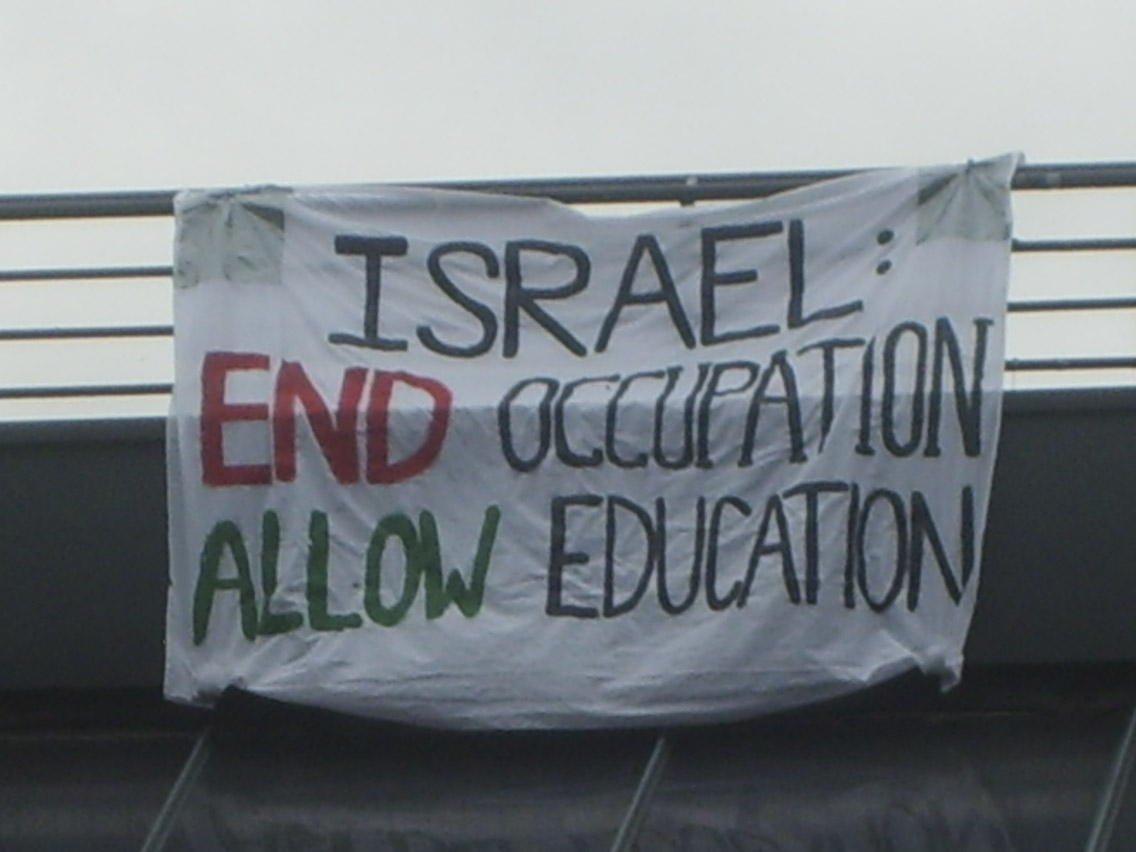
To deny education to the Palestinians is to quintessentially deny peace and hope to the Middle East.
Education is an intrinsic right, one, which helps mould individual personalities and forge great nations: it is a tool as it is a weapon. A tool, which has been constantly obstructed and denied by the State of Israel who spends 10% of its GDP on its own education system, with blatant disregard for the 40 000 Palestinians students which it has deprived of an education to for this academic year. Palestinians require education as an alternative means of resistance so that they can assess the problems in their society, which have precluded them from ending the illegal occupation.
In response to this, the LSE’s Palestine Society has taken an active stance to not only raise awareness about Israel’s orchestrated means of undermining and crippling the development of the Palestinian society as a whole, but also by pioneering dynamic initiatives such as the opening up of LSE’s electronic resources (within copyright restrictions) to Palestinian Universities.
As a university of the Social Sciences, we recognise the necessity, importance and power which education provides us with and we bear a duty to promote this to other students less fortunate than ourselves. With the support of academics and the majority of the student body, the LSE is aiming to create a strong foundation upon which Palestinian universities can share our resources and build strong links between students, whether this is through letters, Facebook or Skype, it is the principle that there is on-going communication between students, sharing of knowledge and hence galvanising hope for people persecuted in their own land.
This progressive initiative will offer the Palestinians a whole new perspective on matters, however will most importantly highlight the LSE standing in solidarity with not only the Palestinians but also with the core values and principles that define our society – justice, freedom and the right to education. Core values and principles audaciously violated by the State of Israel.
Talks are already in place with other British Universities to follow in suit: the LSE’s Right to Education Campaign aims to mobilise and strengthen partnerships between UK and Palestinian student bodies and professors, so that united we can strategically challenge the prevalent injustices faced by Palestinian students.
We may not be able to participate in peace talks or have direct pressure over the actors making the decisions, but we can empower the Palestinian students with a gift far more sustainable and superior than money – education. Through education a stronger more united society will develop, a more aware, creative and inspired generation will be shaped: a generation that will seek peace not through the injustices of Israel or through the ideology of Hamas.
Education for the Palestinians will ultimately create individuals and ergo a nation that is self-reliant, independent and sovereign. A nation that we can call Palestine.
Subscribe to:
Posts (Atom)