Showing posts with label peace. Show all posts

Sunday, 10 April 2011

In The Name of "Peace"

1 comments
By Sameeha Elwan
(student from Palestine)


It is a time of peace.
Peacefully, you wake up every morning with the most peaceful intentions of leading a peaceful day in your already chaotic life.


Whether you intended or it was predestined, the voice of Fairouz with which you prefer to sip your morning coffee, peacefully, avoiding all sort of news of conflicts, death, or pain on other radio stations turns into an agonizing pain with the “bells of return” triggering in your mind, you who were destined to chant for Palestine as long as you’re forced to live elsewhere.


Peacefully, you get into the taxi while your mind is so full with the most peaceful thoughts of how to peacefully resolve the argument that might take place with your boss. You take your mind of those aggressive thoughts, and prefer to stare out of the car window longing for peace. 


Only there, your eyes meet with fixed eyes of hundreds of faces hanging on the walls of the streets. You might recognize one or two or even tens; you who have lost so many who once have been the joy of your life. They used to be the joy of your life till they were killed, shot, shelled, torn, burned, or buried under rubbles. Now, they have turned into some temporarily memorials on the walls who would soon be replaced by others.


Peacefully, you go shopping for the Eid the day before with the most peaceful intention of a usual shopping day where all you think about is whether you’d find that red blouse. The only act of aggression would be directed towards the salesman with whom you argue, peacefully. The rising clamour of people around you is suddenly replaced by screams of terror as a bombing shakes the place.


 In seconds, you resume your enthusiastic argument with the salesman, peacefully; you who learned how to estimate possible danger. You no longer need a media coverage that would assure you the bombing was carried out by an F16 in a place far away. You already know, and continue shopping, peacefully
Wait a minute,


Your understanding of the word “peace” is mistaken. Peace is no longer a “state” of mind. It is rather a process. Please be informed that for peace to be processed, certain acts are obligatory:


Forget:
Forget about the word freedom. Freedom is a relative term invented by absolute idealistic people. Freedom should always be put under extreme supervision and restriction or else it would go beyond control. You should learn to live under some absolutely not harmful restrictions. Checkpoints are only there for safety reasons and hundreds of them dotted along the road of the West bank, though would restrict your movement for a short while that might cost you the life of a human being, are put there for the sake of ensuring the Peace process.


Forget about your history. Your history is worth nothing. It should start by the year 1967 where all what was left for you was the West Bank, partially and the Gaza Strip. A history of thousands of years should be erased of your memory and you should learn to accept that Palestine is only the pieces of land scattered around the borders of 1967.


Forget about the word Return. This is a term preserved only for Jews who claim to be displaced all around the world thousands of years ago. Palestinians who were tragically dispersed all around the world sixty two years ago should learn to just live where they are.


Forgive:
Be tolerant and learn to forgive. Forgive them the wars they wage, the massacres they commit, the blood they shed, the children they slaughter, the women they rape, the lands they erase, the trees they uproot, the torture they enjoy, and the humiliation they cause. Forgive them anything, and learn to live in Peace.
Forgive them and shake their dirty hands stained with your people’s blood and draw a smile upon your face before the camera for a shameful photograph.


Forgive them and smile to them while you ask your people to lay down arms and bid them farewell. Barehanded you stand before them, with not even a branch of olive, for you already lost that.

As long as you choose to live that peace, then our prayers to you to “Rest In Peace”.

Friday, 10 December 2010

The Arab - Israeli Talks: Politics Does Not Achieve Peace. The Individual Does.

1 comments
Charlotte de Wynter
 
"Throughout history, fairly arbitrary lines drawn on maps have determined who prospers and who needs, who eats and who starves, who attacks and who is attacked, who lives long and who dies young. Oh, we have been slaves to those lines for so long..."
- Gavin de Becker 

Noble ideas of justice, controversial questions on settlements and the Palestinian right of return: topics being thrown to and fro by four men under the veneer of eloquent and articulated language. In the comfort of the beautiful Sharm el Sheikh, under the security of Egyptian and Israeli forces, under the wise auspices of the enlightened Hillary Clinton, four actors again try to entertain me with their humble words, naive strategy and impressive diplomatic skill. Is is this not the perfect setting for a typical Shakespearean tragedy, "Much ado to talk about nothing"? 

The curtains have been parted, the actors pruned and prepared with their masks, their words chosen, their role and ideas pre-defined not by rationale but by script, the applause starts and the audience will laugh, cry and jeer. Look a little closer and you may see that young Palestinian girl, Iman al Hams, hiding in the reflection of the eye of the gun just before her body was ripped apart by 50 bullets, or perhaps you'll manage to catch a glimpse of that Iron Wall - built in the name of democracy, peace and security which is actually a way of controlling the lives of Palestinians, reinforcing division, prejudice and discrimination. If you are lucky, under all the banter you'll here a snippet of those "legal" settlements in the West Bank where Jews live in their economic luxury whilst only a few hundred metres away Palestinians are struggling on a daily basis. Sorry, I forgot to mention this is the set for the peace talks. The set for change.

Change which will not be found in a couple of words strung together and named as a treaty, signed by leaders and applauded by the international community . Why? Because this treaty will not represent the views of the majority of Palestinians: those like Alia Shaheen who are more concerned with their worsening situation in Gaza, lack of electricity and inflation and especially because Abbas is a president who is out of his presidential term. So in whose name is he talking? In the name of Palestinians?

 What about the 1.5 million in Gaza where a majority support Hamas? Moreover for change to occur not only is it a gradual process but it involves the slow change of mentality, which comes with understanding. Understanding which has not been found because there is no communication. Communication which is hindered because of emotion: traumatic past events which block the rationale. Traumatic past events which have led to an asymmetry of power; a strong and a weak side, a strong disparity whose gap needs to be filled to achieve a balance of power. 

With this balance of power comes some basic level of mutual respect, and with this you go to the negotiating table. However, you do not go to negotiation table when you are not prepared to compromise nor when you do not intend to discuss with those who most disagree with you, it is easy getting someone who agrees with you to say they agree with you, after all whether it be Ireland or South Africa, countries would never have achieved any solution had they not begun talking to those whom they did not agree with. 

If Hamas is not ready to talk, if Israel is not ready to compromise with Jerusalem or the illegal settlements, then the time is not ripe for peace talks. The more failed peace talks we have, the more times I feel deja vu but also the stronger the feeling of distrust, disillusion and resentment by not only the Palestinians but by Israelis, and with this dangerous concoction of sentiments breeds resistance.

Resistance against each other. Resistance against communication. Ultimately, resistance against peace. What is needed is not more summits but wiser decision making, risks need to be taken in hope of peace. Israel, being the stronger player needs to reach out with olive branch - if it really wants peace it should show respect and one way to do so would be to not pass the "Jewish Loyalty" Oath, relax the checkpoints, have a stronger sense of morality in the IDF, permit for necessary products to enter Gaza such as cement and of course knock down that Iron Wall built in the name of everything immoral and wrong in this world. 

Naturally this is a gradual process, gradual for definite change. In essence, by raising the standard of living in Palestine the Knesset would be weakening the resistance, especially Hamas. This is of course an obvious strategy which should have been employed by the Israelis should they want peace, but then again this begs the point that the Knesset don't want to appear before Israel. 

Then again in my eyes this isn't being weak but doing what is best for your country in the long run, peace between Palestine and Israel means a secure Israel, a lesser threat from Iran due to lower levels of support and an Israel which isn't always at risk, where after centuries of persecution the Jews could live in relative peace.

The decision is in quintessence that of Israel. It is the stronger player, with access to money and power. It is time for Israel to change tactics and to make decisions which shall define its history in the years to come, and as Obama put it, the politicians are indeed "all fathers, blessed with sons and daughters whose generation will judge them". 

Politicians need to start thinking of a sustainable future, in the sense that Israel cannot be surrounded by enemies forever, America can only so far protect them, a time will come when Israel will have to stand on her own and preferably without the nuclear missiles of the Arab peninsula aimed at her. Like Jamal Elshayyal claims, "What is needed is tangible changes on the ground coupled with brave political decisions to speak and listen to the real players and stakeholders in this conflict."

However the first step for change has yet to be taken, the olive branch has yet to be extended. Peace has yet to be made.

The Palestinian Right To Education

40 comments

By Nadia Marques de Carvalho 


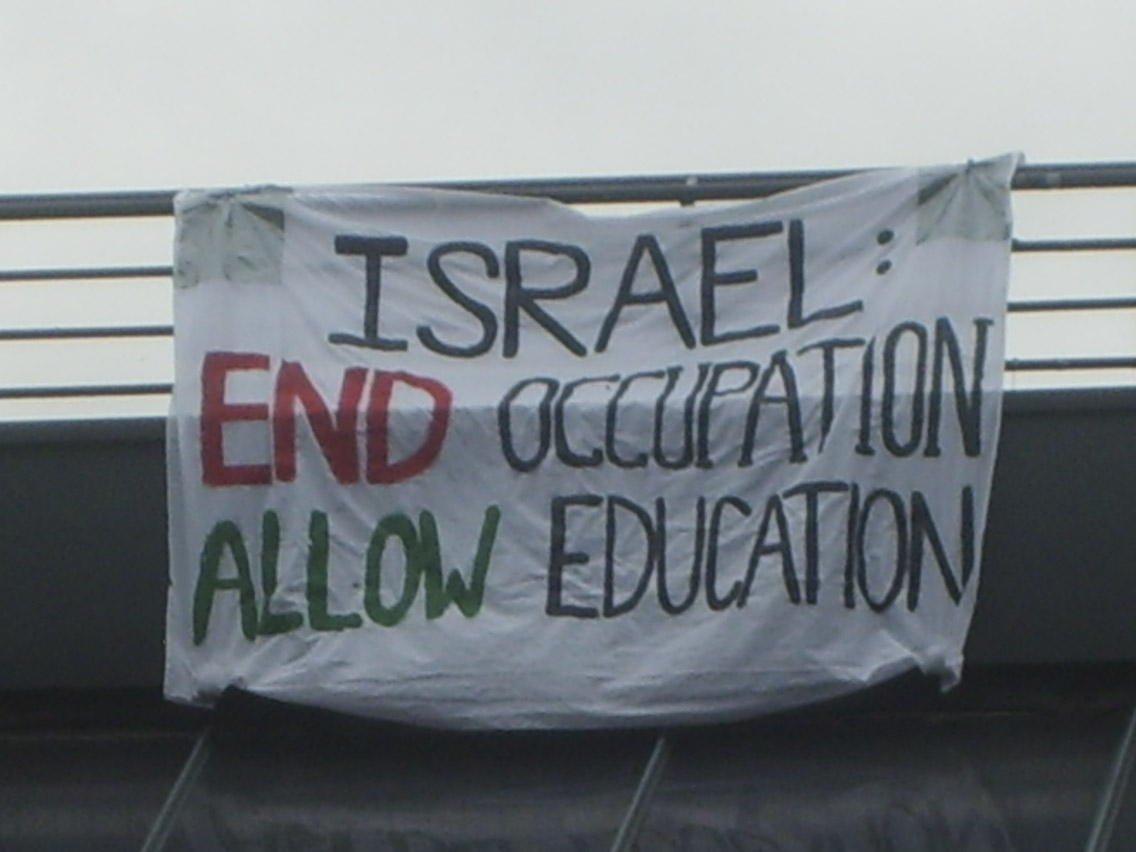
To deny education to the Palestinians is to quintessentially deny peace and hope to the Middle East.


 Education is an intrinsic right, one, which helps mould individual personalities and forge great nations: it is a tool as it is a weapon. A tool, which has been constantly obstructed and denied by the State of Israel who spends 10% of its GDP on its own education system, with blatant disregard for the 40 000 Palestinians students which it has deprived of an education to for this academic year. Palestinians require education as an alternative means of resistance so that they can assess the problems in their society, which have precluded them from ending the illegal occupation. 

In response to this, the LSE’s Palestine Society has taken an active stance to not only raise awareness about Israel’s orchestrated means of undermining and crippling the development of the Palestinian society as a whole, but also by pioneering dynamic initiatives such as the opening up of LSE’s electronic resources (within copyright restrictions) to Palestinian Universities.


 As a university of the Social Sciences, we recognise the necessity, importance and power which education provides us with and we bear a duty to promote this to other students less fortunate than ourselves. With the support of academics and the majority of the student body, the LSE is aiming to create a strong foundation upon which Palestinian universities can share our resources and build strong links between students, whether this is through letters, Facebook or Skype, it is the principle that there is on-going communication between students, sharing of knowledge and hence galvanising hope for people persecuted in their own land.


 This progressive initiative will offer the Palestinians a whole new perspective on matters, however will most importantly highlight the LSE standing in solidarity with not only the Palestinians but also with the core values and principles that define our society – justice, freedom and the right to education. Core values and principles audaciously violated by the State of Israel. 

Talks are already in place with other British Universities to follow in suit: the LSE’s Right to Education Campaign aims to mobilise and strengthen partnerships between UK and Palestinian student bodies and professors, so that united we can strategically challenge the prevalent injustices faced by Palestinian students. 

We may not be able to participate in peace talks or have direct pressure over the actors making the decisions, but we can empower the Palestinian students with a gift far more sustainable and superior than money – education. Through education a stronger more united society will develop, a more aware, creative and inspired generation will be shaped: a generation that will seek peace not through the injustices of Israel or through the ideology of Hamas. 


Education for the Palestinians will ultimately create individuals and ergo a nation that is self-reliant, independent and sovereign. A nation that we can call Palestine.